
Mining Digitalization: Big Expectations, Brutal Reality
Over the last decade mining companies have poured billions into digital initiatives. Mine planning platforms, integrated geological databases, short-interval control systems, real-time dashboards, predictive maintenance, autonomous equipment. The pitch is always the same. Better decisions. Lower costs. Higher margins. More control. Fewer surprises.
On paper it looks perfect. In reality the results are far more brutal.
According to multiple industry reviews and internal post-mortems from Tier 1 and Tier 2 operators, more than half of mining digitalization programs fail to deliver measurable financial value within the first three years. Not “could be better”, but fail to move any KPI that actually matters. Cost per tonne, strip ratio, dilution, recovery, schedule compliance, capital efficiency.
This is not a technology problem. Modern mining software is powerful. Algorithms work. Computing power is cheap. The failure sits elsewhere.
Let’s look at what typically happens. A mining company launches a digital transformation initiative. Budget approved. Steering committee formed. Vendors selected. Licenses purchased. Consultants hired. Everyone is optimistic.
Year one is busy. Data migration. System configuration. Training sessions. Dashboards appear. Reports look cleaner than before. Management feels progress.
Year two is where reality kicks in. The system is technically live, but planners still export to Excel “just to be safe”. Geologists keep parallel models. Production reconciliations take longer, not shorter. Engineers do not fully trust the outputs. KPIs barely move.
By year three the project quietly loses priority. Support contracts remain. Licenses auto-renew. The system is used, but only partially. No one says it failed. Everyone just stops talking about it.
This pattern repeats across commodities, regions, and company sizes. A mid-tier open pit operation invests several million dollars into an integrated planning and scheduling platform. The goal is to optimize pushback sequencing and improve NPV. Two years later the mine plan is still manually adjusted every month because actual production data does not reconcile with the model. The software works, but the input assumptions never reflected operational reality. The economic model is theoretically elegant and practically useless.
An underground mine deploys a digital short-interval control system to improve compliance and reduce dilution. Hardware, software, integration. The result: operators bypass the system during peak shifts because it slows them down. Data quality drops. Management loses trust in reports. The system exists, but decisions are still made based on informal calls and gut feeling.
A development-stage project adopts advanced geological modeling and mine design tools during PEA. The outputs look impressive. When the project moves to PFS, the team realizes the original data structure cannot support higher-confidence studies. Models are rebuilt almost from scratch. Months lost. Investor confidence shaken.
In all these cases the technology did exactly what it was supposed to do. It exposed the weaknesses of the operation.
Digitalization amplifies reality. It does not improve it by default. If data is fragmented, digital systems make fragmentation more visible. If processes are unclear, digital tools highlight contradictions. If ownership is weak, digital platforms turn into battlegrounds between departments.
The biggest misconception in mining digitalization is the belief that software itself creates value. It does not. Value in mining comes from better decisions. Better decisions require trusted data, clear processes, and accountability. Software is only an accelerator. If the underlying system is broken, the acceleration just gets you to the wrong answer faster.
This is why expectations are so high and disappointment so common. Management expects transformation. Teams experience disruption. Finance expects ROI. Operations see complexity. The gap between promise and reality is not measured in frustration. It is measured in millions of dollars quietly written off.
And the uncomfortable truth is this. Most of these failures were predictable before the first license was purchased.
The Core Reasons Digitalization Projects Fail
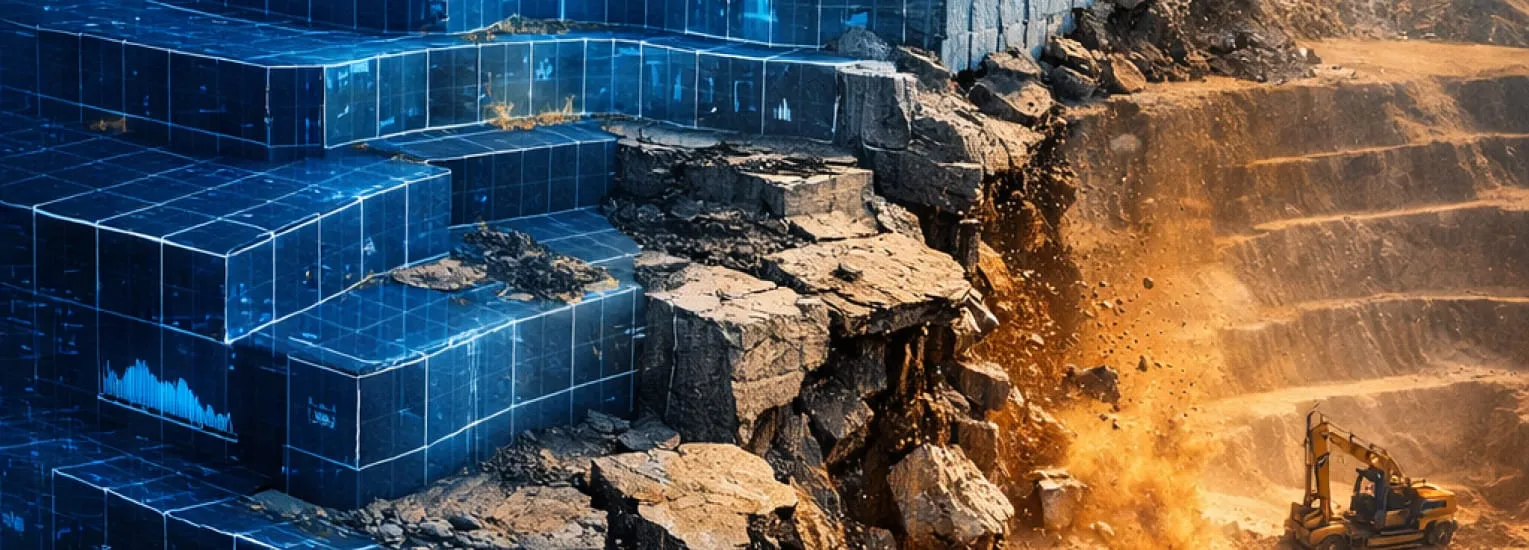
Analysis of failed digitalization programs in the mining industry shows that the causes are remarkably consistent across geographies, commodities, and company size. Independent reviews by consulting firms, internal audits of major operators, and post-implementation assessments point to the same structural issues. These failures are rarely technical. They are systemic.
Below are the dominant failure mechanisms, supported by real data and industry cases.
Poor Data Quality and Structural Data Gaps
The most common root cause is inadequate data readiness at the start of the project.
According to a 2022 industry survey of mining executives conducted by a global consulting firm, more than 60 percent of digital transformation initiatives in mining underperformed specifically due to data quality issues. The problems were not limited to missing data, but included inconsistent coordinate systems, incomplete drillhole metadata, lack of version control in geological models, and weak reconciliation between planning and production datasets.
A well-documented example comes from a large open pit copper operation in South America. The operator implemented an advanced integrated planning and scheduling system intended to optimize pushback sequencing and improve NPV. During post-implementation review, it was found that more than 25 percent of drillholes used in the geological model had inconsistent collar elevations due to historical survey errors. These discrepancies were small individually, but collectively distorted block model grades and tonnage estimates. The digital system produced mathematically correct outputs based on fundamentally flawed inputs. As a result, mine plans consistently deviated from actual production, eroding trust in the system and forcing planners back to manual corrections.
In another case, an underground gold mine in West Africa attempted to deploy a digital short-interval control platform. While the system itself functioned correctly, production data capture was incomplete and delayed, with manual entry often occurring days after blasting. The absence of near-real-time, reliable production data rendered the digital control logic ineffective. The system could not close the feedback loop it was designed for.
These cases illustrate a critical point. Digital tools do not compensate for weak data foundations. They require them.
Digitalization Without Process Reengineering
A second major failure driver is the introduction of digital tools without corresponding changes to operational and planning processes.
Multiple post-mortem reviews show that mining companies frequently overlay new software onto legacy workflows. Engineers continue to rely on spreadsheets for critical calculations, production teams bypass digital reporting during peak shifts, and reconciliation processes remain manual. The digital system becomes an additional layer rather than a replacement.
A 2021 benchmarking study across Tier 1 and Tier 2 mining companies found that in projects where core planning and reporting processes were not formally redefined, software adoption rates plateaued at 30 to 40 percent of intended functionality. In contrast, projects that included explicit process redesign achieved adoption levels above 70 percent within two years.
A practical example comes from an iron ore operation in Australia. The company implemented an enterprise mine planning solution intended to unify geology, design, scheduling, and reporting. However, no changes were made to the monthly planning cycle or approval workflows. Planners continued to maintain parallel Excel-based models for internal validation. Over time, discrepancies emerged between the system outputs and the spreadsheets. Management defaulted to the spreadsheets, effectively sidelining the digital platform.
The software did not fail. The organization failed to change how decisions were made.
Lack of Clear Ownership and Governance
Another structural weakness is the absence of a clearly defined owner for the digital product on the client side.
In many mining companies, digitalization initiatives sit between IT departments, technical services, and operations. IT focuses on infrastructure and cybersecurity. Engineers focus on technical accuracy. Management focuses on reporting. Without a single accountable owner responsible for value delivery, projects drift.
Industry audits consistently show that digital programs with no designated business owner are significantly more likely to miss timelines and budgets. One internal review across multiple operations of a global mining group found that projects without a named product owner experienced schedule overruns averaging 40 percent compared to those with clear ownership.
A notable case involves a polymetallic mine in Eastern Europe. The company deployed a modern geological modeling and mine planning suite. Responsibility for implementation was split between IT and technical services. IT managed deployment and licensing. Technical services assumed data accuracy would be addressed later. No one owned end-to-end decision quality. The result was a technically functional system that was never fully trusted by operations or management.
Digitalization without ownership becomes an IT expense rather than a business asset.
Overambitious Scope and Big-Bang Implementation
Many mining digitalization projects fail due to excessive initial scope.
Instead of prioritizing specific business problems, companies attempt to digitalize geology, planning, production, maintenance, and reporting simultaneously. This big-bang approach increases integration complexity, stretches internal resources, and delays value realization.
Data from capital project governance studies in the mining sector indicate that large-scale digital programs with broad initial scope are more than twice as likely to be paused or restructured within the first three years compared to phased implementations.
A clear example comes from a coal operation in Asia that attempted to implement a fully integrated digital mine platform across multiple sites in a single rollout. Integration delays, inconsistent data standards between sites, and limited internal capacity led to repeated schedule slippages. After three years and significant expenditure, the program was scaled back to a limited planning use case, abandoning much of the original vision.
Why Digitalization Failure Is So Expensive
The financial impact of failed digitalization initiatives in mining is systematically underestimated. Most companies account for the direct costs of software licenses, integration, and consulting. Far fewer quantify the indirect economic damage caused by distorted decisions, delayed projects, and weakened investor confidence.
In practice, indirect losses frequently exceed direct digitalization costs by an order of magnitude.
Direct Costs Are Only the Visible Part
Direct costs are easy to identify. Software licenses, implementation services, hardware, integration work, training, and ongoing support. For mid-size operations, total digitalization budgets typically range from several hundred thousand to several million dollars per site. For multi-site or group-wide initiatives, budgets can exceed tens of millions.
When projects underperform, these costs are usually classified as sunk costs and written off quietly. The assumption is that the damage ends there. This assumption is wrong.
Distorted Planning Decisions and Value Leakage
The largest economic losses occur through suboptimal planning decisions driven by untrusted or misleading digital outputs.
Mine planning software directly influences pushback sequencing, production schedules, cut-off grades, and capital deployment. Even small deviations between model assumptions and operational reality can have outsized financial effects.
A documented internal review of an open pit operation producing base metals showed that a one percent error in average head grade estimation, propagated through life-of-mine planning, resulted in NPV sensitivity of several tens of millions of dollars. The digital planning system produced internally consistent plans, but the geological model used outdated reconciliation factors that were never corrected during implementation.
In another case, a hard rock underground mine introduced a digital scheduling platform intended to improve development sequencing and reduce idle time. Due to incomplete integration with actual equipment availability and shift-level constraints, schedules were consistently optimistic. The mine repeatedly missed development targets, leading to delayed stoping and unplanned capital reallocation. The cost impact was not attributed to digitalization, yet the system shaped the decisions that caused it.
Digital tools do not just support decisions. They institutionalize them.
Capital Misallocation and Delayed Projects
For development and expansion projects, failed digitalization often manifests as delays and rework.
In several publicly disclosed cases, mining projects entering PFS or FS stages had to revisit earlier digital models due to data and process limitations discovered too late. Geological models were rebuilt. Mine designs were revised. Schedules were reworked. These revisions did not simply cost time. They delayed investment decisions, permitting, and financing.
Industry benchmarking shows that schedule slippage of six to twelve months at the study stage can materially affect project economics through deferred cash flows, increased holding costs, and exposure to commodity price cycles. Digitalization failures at early stages therefore translate directly into reduced project value.
Operational Inefficiencies and Hidden OPEX Growth
At operating mines, the economic impact often appears as creeping operational inefficiency rather than acute failure.
Digital systems intended to improve control and coordination instead add complexity. Engineers spend additional time validating outputs. Supervisors maintain parallel reporting systems. Data reconciliation becomes a recurring bottleneck.
Internal time-tracking studies at several operations revealed that planners and engineers spent between 10 and 20 percent of their time compensating for data and system inconsistencies after digitalization. This hidden labor cost is rarely captured in project ROI calculations.
Moreover, when digital outputs are not trusted, decisions revert to conservative assumptions. This often leads to higher dilution allowances, lower utilization targets, and excessive buffers in schedules. The economic effect is cumulative and persistent.
Investor Confidence and Due Diligence Risk
Digital maturity is increasingly scrutinized during technical and financial due diligence.
Investors and lenders rely on digital models, data traceability, and reconciliation logic to assess risk. When digital systems are fragmented or inconsistently used, confidence in forecasts erodes.
In multiple transactions involving operating assets, due diligence teams have flagged weak digital foundations as risk factors, leading to valuation haircuts or increased contingency assumptions. While rarely stated explicitly, the inability to demonstrate reliable, integrated planning and reporting undermines credibility.
In this context, failed digitalization does not just destroy internal value. It affects how external stakeholders price risk.
Why These Losses Are Rarely Attributed to Digitalization
One reason the economic impact remains underestimated is attribution.
When mine plans miss targets, the causes are typically attributed to geology, operations, or market conditions. Digital systems are treated as neutral tools. In reality, they shape assumptions, constrain scenarios, and influence decisions at every level.
Because digitalization failures rarely cause immediate operational breakdown, they escape scrutiny. The cost is paid gradually through suboptimal decisions, delays, and inefficiencies.
By the time the financial impact becomes visible, the digital project is already considered complete.
A Smarter Way to Digitalize a Mine
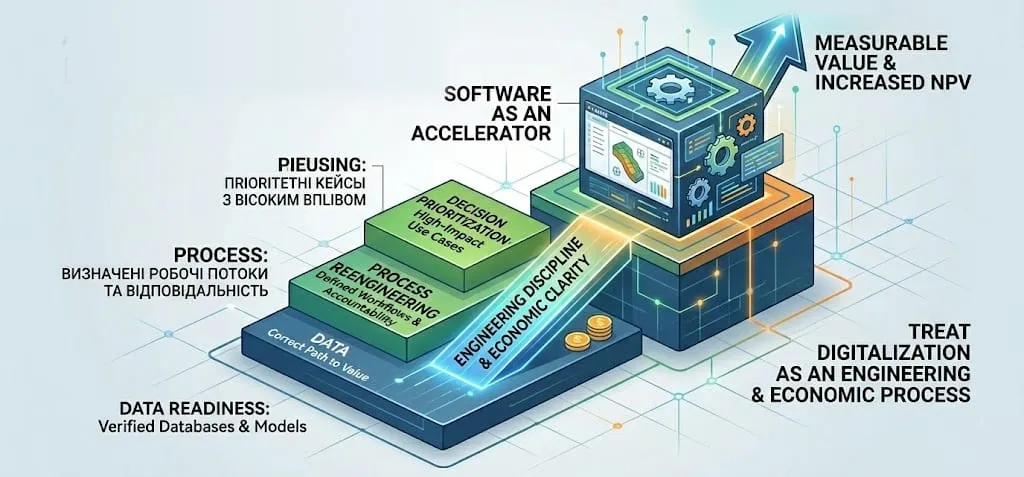
Analysis of successful digitalization programs in mining shows a clear pattern. Projects that deliver measurable value follow a fundamentally different logic compared to those that fail. They treat digitalization as an engineering and economic exercise, not as an IT rollout.
The difference is not in software selection. It is in sequencing, scope definition, and governance.
Start With Decisions, Not Tools
Successful projects begin by identifying a small number of high-impact decisions that materially affect value. Examples include pushback sequencing, cut-off grade strategy, development prioritization, or production schedule compliance.
Only after these decisions are defined does the question of tools arise.
A comparative review of multiple mine planning initiatives across operating and development-stage assets showed that projects focused on two or three clearly defined decision processes achieved measurable improvements within 12 to 18 months. Projects that attempted broad platform implementation without decision focus consistently struggled to demonstrate value.
This approach forces discipline. If a digital tool does not directly improve a decision that affects cash flow, it does not belong in the first phase.
Establish Data Readiness as a Gate, Not a Checkbox
In effective digitalization programs, data readiness is treated as a gating criterion rather than a parallel activity.
This includes structured verification of geological databases, reconciliation between modelled and actual production, alignment of coordinate systems, and version control of technical models. Importantly, data readiness is assessed against the intended use case, not against abstract quality standards.
A development project in North America provides a useful example. Prior to implementing advanced mine planning tools for PFS, the project team conducted a formal data readiness assessment. The review identified inconsistencies in density assumptions and incomplete metallurgical linkage to the block model. Rather than proceeding with software implementation, the team delayed deployment and focused on correcting these gaps. While this added several months upfront, it avoided a full model rebuild later at a much higher cost.
This discipline is rare, but it is one of the strongest predictors of success.
Limit Initial Scope and Deliver Early Value
Another defining characteristic of successful programs is incremental implementation.
Rather than attempting to digitalize the entire mine, effective teams prioritize a narrow scope that can deliver early, visible results. This might involve a single planning horizon, a subset of the orebody, or a specific operational constraint.
Empirical data from mining project governance studies shows that phased digital implementations are significantly more likely to meet timelines and budgets. Early value delivery also plays a critical role in sustaining internal support and funding.
In contrast, big-bang programs often consume resources for years before producing usable outputs, increasing organizational fatigue and skepticism.
Assign Clear Ownership and Decision Accountability
Governance structure is another critical differentiator.
Successful digitalization initiatives have a clearly defined owner on the business side, typically within technical services or operations. This individual is accountable for decision quality and value delivery, not just system availability.
The presence of a business owner changes behavior. Data issues are addressed earlier. Process changes are enforced. Trade-offs between accuracy, speed, and usability are made explicitly.
A review of internal programs at a multinational mining group showed that projects with a designated product owner achieved faster adoption and higher utilization rates. Projects without clear ownership consistently devolved into IT-managed systems with limited operational impact.
Digitalization without accountability produces infrastructure. Digitalization with ownership produces decisions.
Align Incentives and Performance Metrics
Human factors cannot be addressed through training alone. Incentives matter.
In successful cases, system usage and data quality are explicitly linked to performance metrics and management expectations. Engineers and supervisors are evaluated not only on outputs, but on adherence to digital workflows.
An underground operation that introduced digital short-interval control achieved sustained adoption only after linking shift reporting compliance to supervisory performance reviews. Prior to this change, system usage remained inconsistent despite repeated training efforts.
This alignment does not require punitive measures. It requires clarity that digital systems are not optional.
Treat Digitalization as a Continuous Engineering Process
Finally, effective digitalization programs recognize that implementation is not an end state.
Mining conditions evolve. Orebodies change. Operational constraints shift. Digital systems must be continuously maintained, audited, and adjusted to remain relevant.
Projects that budget only for initial deployment and ignore long-term governance often degrade over time. Models drift. Assumptions become outdated. Trust erodes.
By contrast, programs that incorporate periodic technical audits and structured feedback loops maintain relevance and credibility.
Practical Recommendations From K-MINE: How to Avoid These Failures
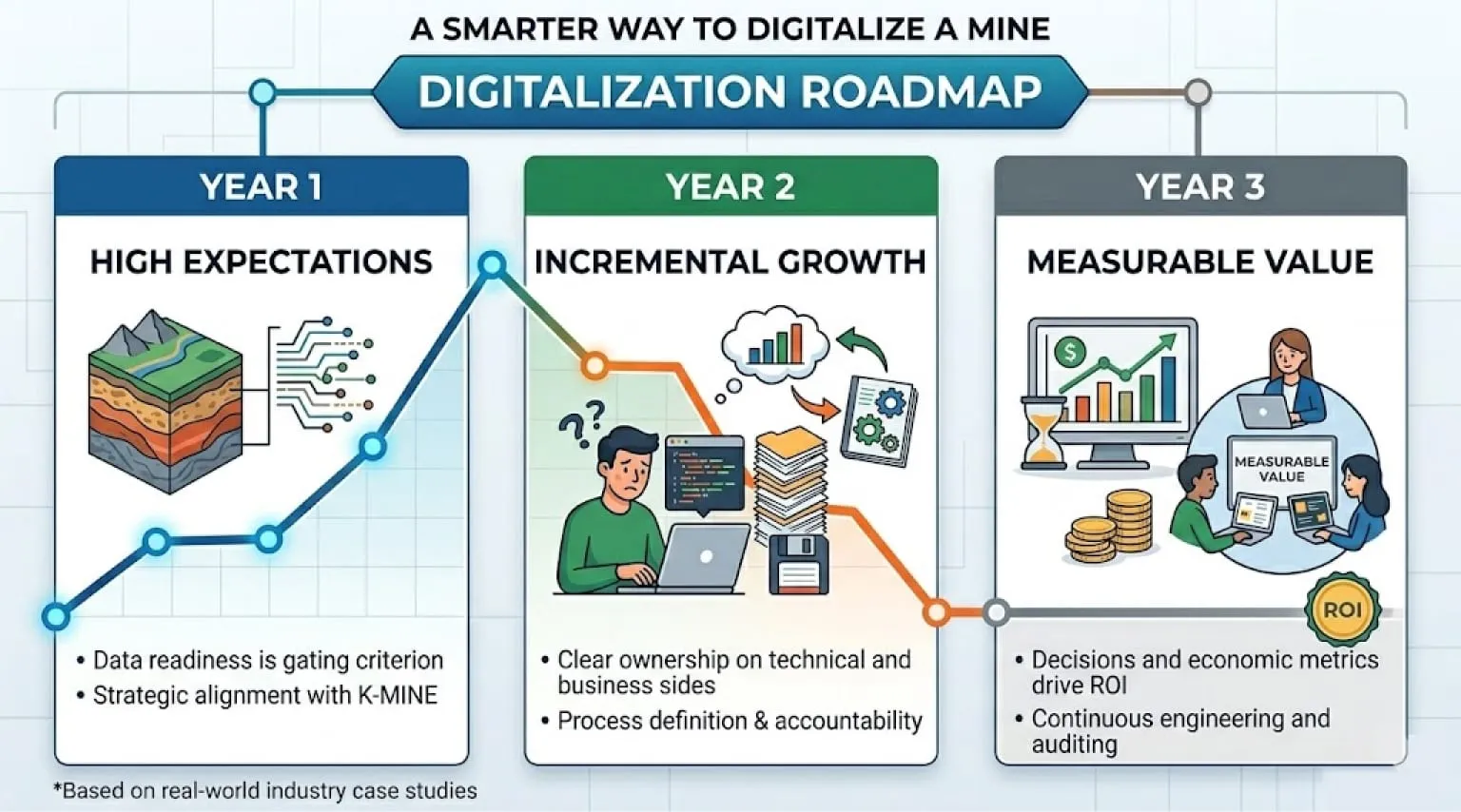
From our experience working with operating mines, development projects, and technical teams across different commodities and jurisdictions, one conclusion is consistent. Successful digitalization in mining is not driven by software choice. It is driven by engineering discipline and economic clarity.
Below are the principles we apply in our own projects and recommend to any mining company considering digital transformation.
Start From Engineering Reality, Not From Software Architecture
Digital initiatives should be anchored in how engineers actually work. Geological interpretation, mine design logic, scheduling constraints, reconciliation cycles. Software must support these workflows, not redefine them artificially.
Projects fail when systems are designed around idealized processes that do not exist on site. They succeed when digital tools reflect operational reality, even if that reality is imperfect.
Before any implementation, we focus on understanding how decisions are made today, not how they are supposed to be made.
Treat Data as a Production Asset, Not as a Byproduct
In many mining operations, data management is treated as secondary to production. This approach is incompatible with digitalization.
Geological databases, models, designs, and schedules are production assets. They require ownership, version control, validation rules, and regular audits. Without this discipline, digital systems will inevitably drift from reality.
In successful projects, data readiness is established before advanced tools are introduced. Where gaps exist, they are addressed explicitly, not deferred.
Implement Software as Part of the Production Process
Digital tools must be embedded into formal planning and operational cycles. Monthly plans, short-interval control, reconciliation, reporting. If a system sits outside these processes, it will never influence decisions.
This requires process definition, role clarity, and management enforcement. It also requires resisting the temptation to maintain parallel systems for comfort.
When software becomes the single source for specific decisions, value follows.
Limit Scope and Build Confidence Incrementally
We consistently recommend starting with a limited scope focused on one or two high-impact use cases. This could be a specific planning horizon, a single pit or mining area, or a defined scheduling problem.
Early success builds trust. Trust drives adoption. Adoption creates value.
Large-scale rollouts without proven internal confidence almost always fail.
Assign Clear Ownership and Measure Value in Economic Terms
Every digital initiative must have a named owner on the client side who is accountable for outcomes. Not system uptime. Not report delivery. Outcomes.
Performance metrics should be linked to decision quality and economic impact. Improved schedule compliance. Reduced dilution. Better capital sequencing. These are measurable and meaningful.
Dashboards without economic linkage are decoration.
Accept That Digitalization Will Expose Weaknesses
Finally, mining companies must accept an uncomfortable truth. Digitalization will reveal problems that were previously hidden. Inconsistent data. Unclear processes. Conflicting assumptions.
This is not a failure of software. It is a diagnostic outcome.
Projects succeed when organizations are willing to address these weaknesses rather than work around them.
Final Thoughts
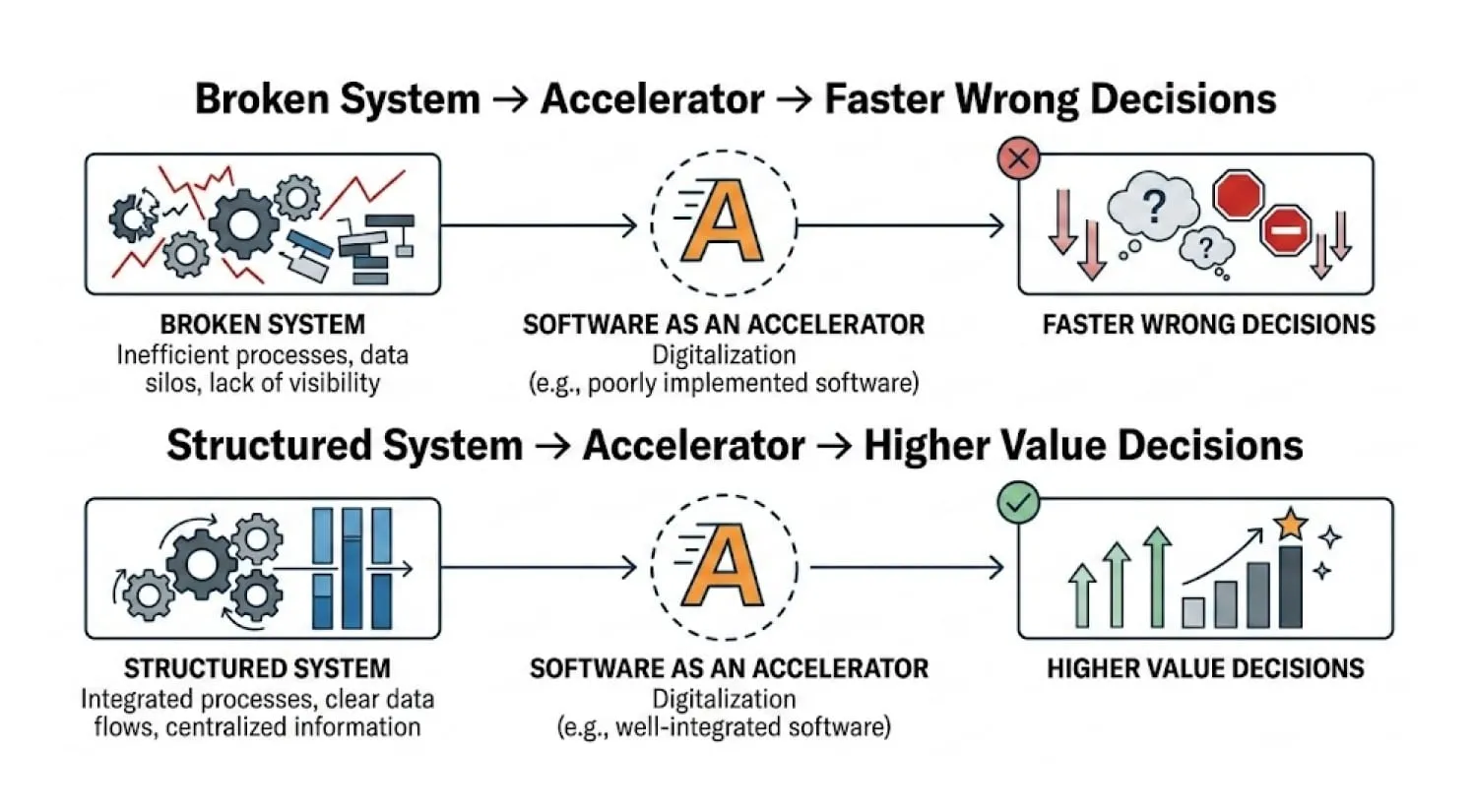
Digitalization in mining is neither a miracle nor a trend. It is a multiplier.
In well-structured operations, it accelerates good decisions and improves capital efficiency. In poorly structured ones, it magnifies existing problems and makes them visible.
Most failed digitalization projects did not fail because of technology. They failed because foundational engineering and organizational issues were ignored.
These failures are predictable. More importantly, they are avoidable. Mining digitalization works when it is treated as what it truly is. An engineering and economic transformation supported by software, not the other way around.