
Underground Mine Design Software
Design Networks. Build Declines. Plan Development.
Design underground mine workings from conceptual layouts to detailed development plans. Build connected excavation networks, create declines and ramps with gradient and curvature control, and plan development drilling patterns for headings. Integrate designs with block models to estimate tonnage, grade, and dilution and generate ground support material quantities. Request a demo to review your underground design workflow in K-MINE.
 Download Presentation
 Design Connected Networks
Build excavation networks with logical connectivity and geometry controls that match site standards.
Create Declines and Ramps
Define alignments parametrically with gradient, curvature, and routing constraints, then update geometry when inputs change.
Quantify Designs With Block Models
Estimate tonnage, grade, and dilution within design volumes to support planning decisions.
Calculate Ground Support Quantities
Generate material quantities and support passports for bolts, mesh, shotcrete, and steel sets.
Design Underground Mine Workings
Design tunnels, declines, shafts, and other workings using multiple construction methods. The module supports various mining methods and adapts to geological conditions with tools for drift, roadway, and raise design. Define cross-section profiles, apply geometric constraints, and generate wireframes and solids for volume calculations. Keep designs aligned with operational requirements such as equipment clearances, haulage geometry, and ventilation access.
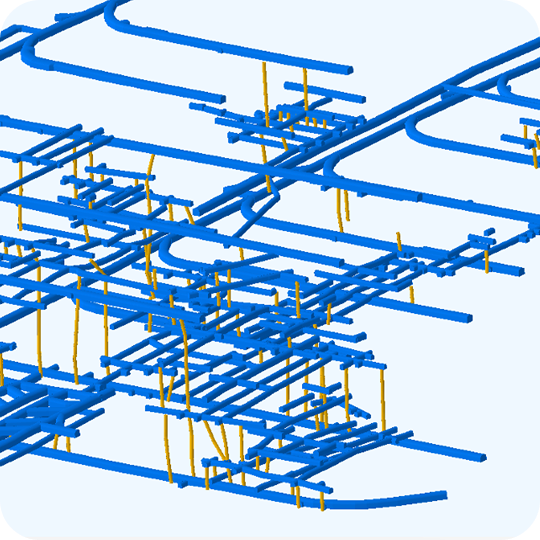
Generate Excavation Networks Automatically
Build underground workings as a connected network with automatic geometry and connectivity control. Use reference points such as shaft locations to define relationships between levels and openings. Apply geometric and technological constraints to match equipment requirements and internal standards so the resulting network can feed mine planning, ventilation analysis, and scheduling workflows.
Design Declines and Ramps
Design declines and ramps with explicit control of gradient, curvature, and alignment. Build geometry using straight segments, arcs, and snap-to-point routing for precise layouts. Update the full ramp dynamically when slope, radius, or direction changes so you can evaluate alternatives quickly while staying within haulage and equipment limits.
Plan Development Drilling and Blasting
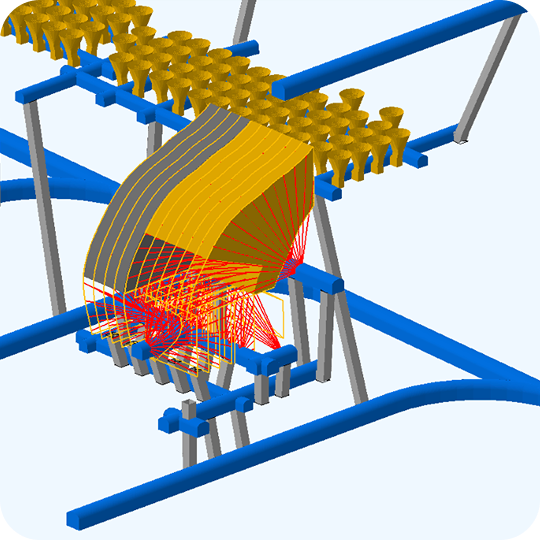
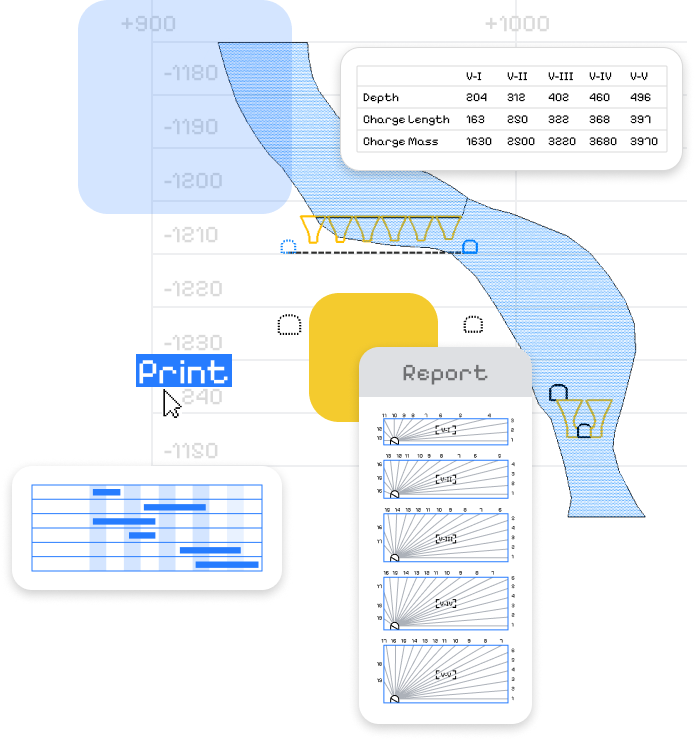
Plan drilling patterns for development headings, including fan and ring configurations. Design blasthole fans with control over hole positioning, spacing, angles, and depths for production drilling. Create beam patterns for development rounds and place patterns directly on faces using cross-sections where needed. Adjust layouts as geology and excavation geometry change while keeping parameters consistent for execution.
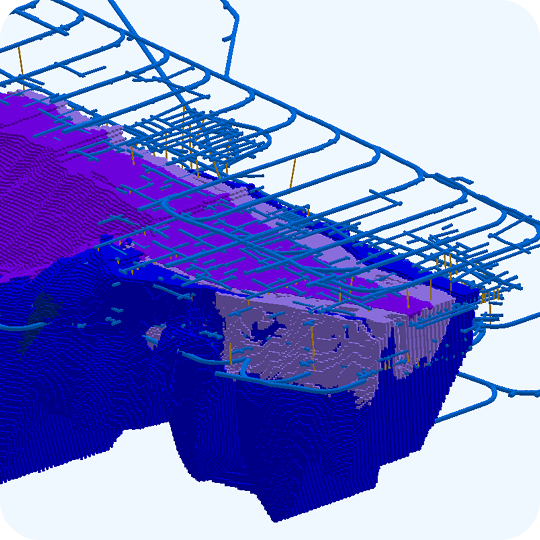
Integrate With Geological Models
Use block models inside the design workflow to quantify underground layouts. The block model provides spatial representation plus quantitative and qualitative calculations for any design volume. Calculate tonnage, grade, and dilution for stopes and development volumes, optimize layouts based on actual geological structure, and improve accuracy of production forecasts and resource estimates.
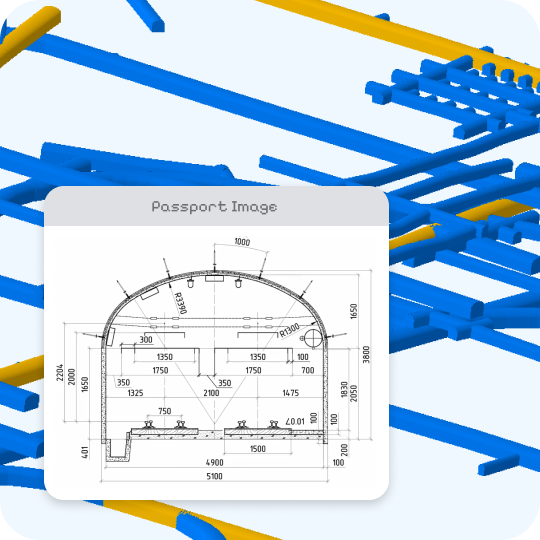
Calculate Ground Support Materials
Calculate ground support requirements for mine workings and generate support passports that define section parameters, material types, and installation specifications. Quantities are calculated from working length, spacing rules, and completeness requirements and can include bolts, mesh, shotcrete, steel sets, and other support elements for procurement planning.
Generate Sections for Planning
Generate cross-sections through workings, ore bodies, and geological structures. Visualize mine geometry in 2D sections for analysis and planning of extraction sequences. Combine development, stopes, geological contacts, and block model grades in one section view and export sections for operations communication and technical documentation.
Digitize Legacy Plans
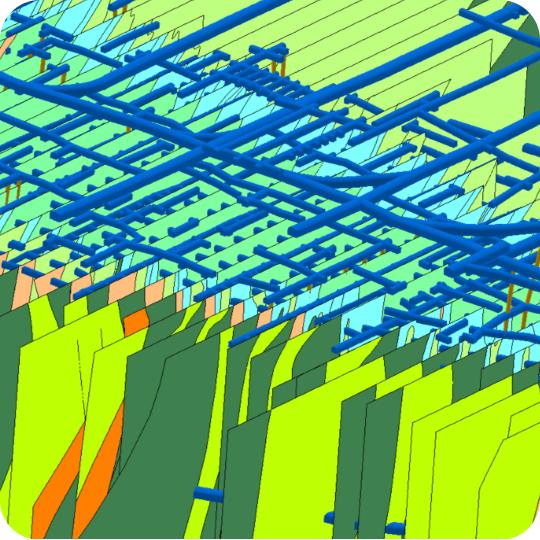
Convert paper drawings, scanned plans, and legacy schematics into 3D objects. Trace historical documents to create wireframes and solids in the current coordinate system and bring legacy data into current design workflows.
Report and Export Deliverables
Generate technical reports with volumes, tonnages, and material quantities. Export maps, sections, and 3D views as CSV, PDF, or DXF for inclusion in documents and presentations. Share outputs with project teams using standard formats so stakeholders can review results as maps, databases, or interactive 3D models without requiring full software licenses.






We offer Mining Consulting!
K-MINE combines deep engineering experience with advanced software capabilities, helping mining companies improve operational performance and profitability.
Frequently Asked Questions
Underground mine design software creates 3D layouts of tunnels, declines, shafts, and stopes and supports development planning. It helps teams build connected networks and quantify designs using geological data.
The system builds connected excavation networks using reference points such as shaft locations. Geometric and technological constraints help keep designs aligned with equipment requirements and internal standards.
Yes. Parametric decline design provides control over gradient, curvature, and alignment, with dynamic recalculation when inputs change.
Block models can be used in design workflows to calculate tonnage, grade, and dilution for stopes and development volumes using geological attributes.
You can calculate quantities for bolts, mesh, shotcrete, steel sets, and other support elements and generate support passports with material lists for procurement.
Request a Demo
See how this module can help your mining operations.