
Where Mining Projects Really Lose Time
Most mining projects do not lose time because geology is weak or because scheduling teams lack technical competence. In many cases, both groups are highly capable. The real losses begin in the space between them - when geological interpretation, mine design, and scheduling are treated as separate deliverables rather than as one connected engineering workflow.
That gap creates rework, version drift, manual data transfer, and slow decision cycles. And this matters more than ever today. As mining companies push toward more connected operations, better data environments, and AI-enabled productivity, the value of those efforts depends on one simple condition: information must move cleanly across disciplines.
A geological model is not valuable simply because it is detailed. It becomes valuable when it can be translated into mineable shapes, practical phases, and a schedule that the operation can actually execute. That sounds obvious, yet this is exactly where many projects begin to break down. A resource model is updated. Pit shells are revised later. Phase design is adjusted in another environment. The scheduling team rebuilds inputs manually, often with slightly different assumptions. By the time management sees the final production schedule, it may already contain invisible disconnects from the geology it was meant to represent.
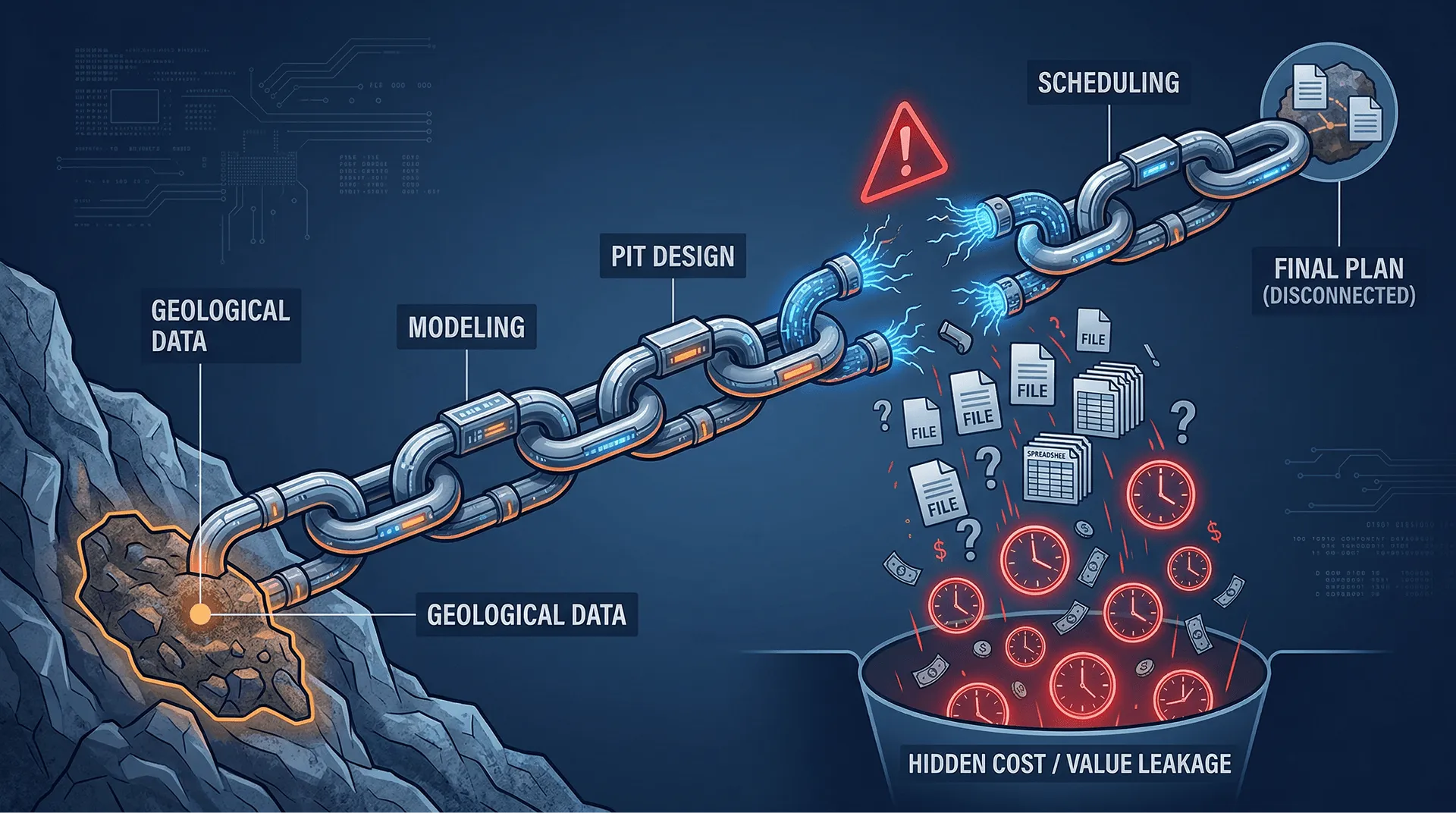
This is not just a software inconvenience. It is a business problem. When a project team cannot move efficiently from updated geology to a revised mine schedule, the cost shows up everywhere: slower scenario testing, delayed studies, lower confidence in production targets, and weak traceability when assumptions change. In practice, engineers end up spending too much time rebuilding, checking, exporting, reconciling, and defending versions instead of improving the plan itself.
The damage is especially visible during PEA, PFS, and FS work, where even relatively small upstream changes can trigger disproportionate downstream rework. A revised ore boundary may force phase redesign. A topography correction may affect access logic. A geotechnical update may alter slope geometry. A processing assumption may change cut-off logic. None of these events are unusual. The real question is whether the project can absorb them quickly, consistently, and transparently - or whether each one triggers another round of manual reconstruction across departments.
For industry professionals, this is where the conversation needs to become more honest. The classic handoff model - geology builds the model, planning builds the shapes, scheduling builds the sequence, operations inherit the result - is often too slow for the way mines actually evolve. A technically correct output is not enough if it takes too long to update, too much effort to reconcile, or too many spreadsheets to trust.
The projects that move better are usually not the ones with the most impressive presentation deck. They are the ones that can translate new geological understanding into updated engineering decisions with less friction and more confidence. That is the real workflow advantage - and it is where a surprising amount of project value is either protected or quietly lost.
The Geological Model Is the Foundation, Not the Finish Line
In mining, the geological model is often treated as the main technical milestone. That is understandable. It captures the team’s best current interpretation of the orebody, grade distribution, lithology, structure, and — depending on the project — geometallurgical or density behavior. It is the core technical representation of what exists underground.
But a geological model is still only a representation. It does not create value by itself. Value appears only when that model can be translated into mineable shapes, sensible extraction logic, and a schedule that holds together under real operational and economic constraints. That gap between “geologically correct” and “planning-ready” is where many projects begin to wobble.
A technically sound geological model can still be weak as a planning input. This happens all the time. A model may be strong from a resource estimation perspective but still be awkward for downstream use because domains are too coarse for operational selectivity, coding is inconsistent with mining units, dilution assumptions are not aligned with likely extraction geometry, or key variables needed later by planners and schedulers are incomplete or poorly structured.
In other words, a model may be defensible in a reporting context while still creating friction in design and scheduling. That distinction matters because mine planning is not just about estimating what is in the ground. It is about deciding what can be mined, when, in what sequence, under what constraints, and with what economic outcome.
This becomes even more obvious when uncertainty is involved. Grade continuity may look reasonable at block model level, yet the downstream planning implications can still shift materially once the mine begins testing practical sequences, destination strategies, cut-off sensitivity, or blending requirements. A model that looks finished on the geology side may still be only the beginning of the real engineering conversation. A deposit does not become an executable production plan simply because the estimation work is complete.
A common real-world problem appears when geological teams structure models around interpretation and estimation logic, while planning teams need the same data organized around mining decisions. Imagine a deposit where ore-waste boundaries are geologically valid at model scale, but the resulting shapes are too irregular for practical bench-by-bench extraction. Or a stratified deposit where seam behavior is captured correctly, but the model structure is still poorly suited for rapid schedule generation across multiple pits or strips.
Nobody is necessarily wrong in that situation. The issue is that geology and planning are solving different technical problems, and when the workflow between them is weak, the planning team ends up repairing the model indirectly through manual adjustments, local assumptions, and workaround files. That is where hidden value leakage begins - not in one dramatic failure, but in a slow accumulation of engineering friction.
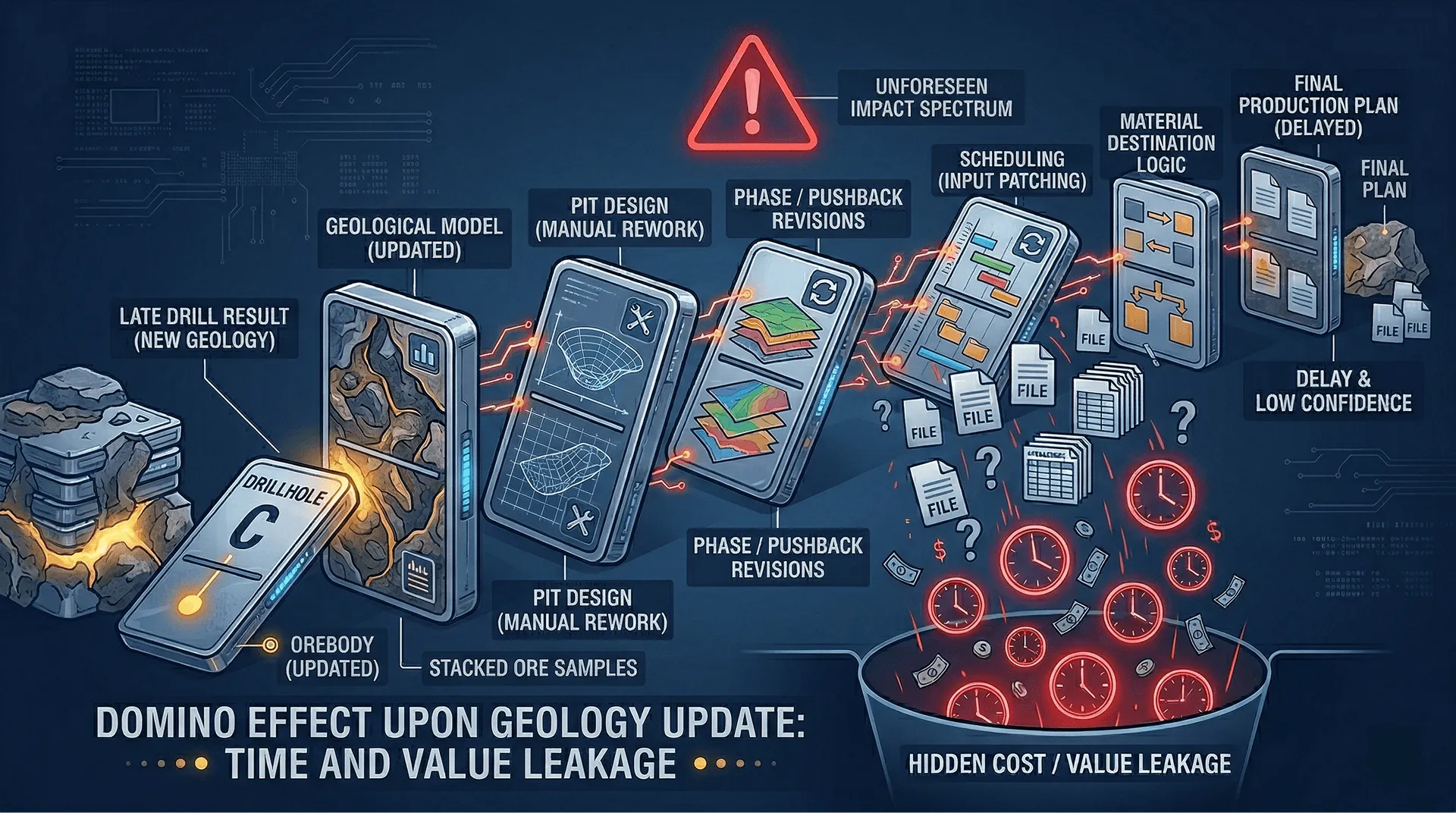
There is also a timing problem. Geological models are not static for long, especially in active operations or fast-moving study environments. New drilling arrives. Domain boundaries are refined. Density relationships are corrected. Topographic control improves. Geotechnical assumptions evolve. Processing constraints become clearer. Every one of those updates can be legitimate and necessary. But if the downstream workflow is brittle, even a modest model revision can trigger a painful chain reaction of redesign, reflagging, re-export, rechecking, and schedule rebuilding.
That is why experienced teams tend to think about geological models in two layers at once. The first is geological defensibility. The second is operational usability. A good model for modern mine planning has to support both. It has to be credible enough for estimation and reporting, but also structured in a way that allows design engineers and schedulers to move quickly into practical alternatives.
The question, then, should not stop at “Is the model correct?” The better question is: “Is the model ready to travel downstream without being rebuilt by hand?”
The strongest projects understand this early. They do not treat geological modeling as a ceremonial deliverable thrown over the fence to planning. They treat it as the first layer of a connected decision chain. That difference sounds small on paper, but in real engineering terms it is massive. One mindset produces a reportable model. The other produces a model that can survive contact with mine design, scheduling logic, operational constraints, and inevitable change.
Where Geology-to-Design Handoffs Start to Fail
If the geological model is the foundation, the first real stress test comes when that model has to become design. This is where many projects begin to lose momentum.
On paper, the transition looks straightforward. Geology defines the orebody, and engineering turns that understanding into pit shells, phases, pushbacks, ramps, haul roads, or underground layouts. In practice, the handoff is rarely that clean. Geological information is often technically valid but not fully structured for design decisions, while design teams are forced to translate, simplify, reinterpret, or manually rebuild parts of the dataset before they can move forward.
That is where time starts disappearing - usually not in one dramatic failure, but through dozens of small corrections, checks, and workarounds.
One of the most common problems is mismatch between geological detail and mining practicality. A model may represent lithology, grades, structures, weathering zones, or seams accurately enough for estimation, but that does not automatically mean it translates well into mineable geometry. Engineers still have to deal with bench height, minimum mining width, slope constraints, dilution, access geometry, equipment limitations, and phase logic. A geologically correct boundary can still be awkward to mine. A domain contact can still be too irregular to support clean design decisions. A seam model can still require adjustment before it behaves well in strip sequencing.
In those situations, the design team ends up doing hidden reconciliation work, trying to bridge the distance between geological truth and practical extractability. That does not mean the geology is wrong. It means the workflow between geology and design is underpowered.
Topography is another classic failure point. Anyone who has spent time around real projects has seen some version of this mess. Drillhole collars were loaded against one surface, then an updated terrain model arrives later from survey or LiDAR, and suddenly collars, contacts, crest lines, access assumptions, or even parts of the design no longer sit where the team thought they did.
The issue is not just visual cleanliness in 3D. A topography correction can change practical access, strip ratios, phase boundaries, ore exposure timing, haul profiles, and even reserve confidence in local areas. If the geological and design environments are loosely connected, this kind of update often triggers manual repair work across solids, strings, surfaces, and design files. What should have been a controlled revision becomes a mini-project of its own.
The same thing happens with coding and model structure. Planning engineers usually need block models or seam models to carry more than grade. They need mining units, material types, destination logic, geotechnical relevance, density consistency, and sometimes geometallurgical variables - all in a structure that can survive filtering and reporting without constant reinterpretation. When that information is incomplete or inconsistently coded, engineers compensate manually. They create local flags, export subsets, patch with spreadsheets, and build temporary layers to make the model usable for design decisions.
This is one of the quietest forms of value leakage in mining because it often looks like normal engineering work, when in reality it is the cost of a weak handoff.
A very practical example is the way pushback design often evolves during studies. A geological update may slightly shift the ore envelope or the internal waste distribution. In theory, that is a normal refinement. In reality, even a modest change can force redesign of phases, access logic, mining widths, and exposure timing. If the workflow is fragmented, engineers may have to regenerate shells, adjust strings manually, recode mining areas, and then reconcile whether the new phase geometry still supports the intended production strategy.
By the time the new design is ready for scheduling, the team has already burned significant time just recovering internal consistency.
There is also a human factor here - and honestly it is one of the biggest. When geology-to-design transfer is weak, trust starts to erode between teams. Geologists feel their work is being simplified or modified downstream. Engineers feel they are inheriting models that are technically elegant but operationally awkward. Schedulers later inherit designs that no longer fully reflect the latest geological understanding. Management sees delays but often cannot tell whether the root cause is geology, engineering capacity, software limitations, or simply poor data flow.
That uncertainty is toxic because it makes every update feel slower and more political than it should be.
Connected workflows separate strong projects from messy ones. When geological and design environments are better linked, teams can update terrain, solids, domains, and design constraints with less manual damage. Engineers can test alternatives faster instead of redrawing everything from scratch. More importantly, they can preserve traceability. The question stops being “Which file is the right one?” and becomes “What changed, why did it change, and what does it do to the design?”
That is a much healthier technical conversation.
The point is not that geology should somehow solve design. It should not. The point is that a project loses value when design begins by repairing the output of geology rather than building on it. Once that happens, every downstream step gets heavier. The pit may still get designed. The stope layout may still get drafted. The reserve may still get reported. But the workflow becomes slower, less transparent, and harder to iterate.
And in mining, slow iteration is expensive.
Why Design-to-Schedule Transfer Creates More Delays Than Teams Expect
By the time a project reaches scheduling, many teams assume the hardest technical work is already done. The geology is modeled, the pit or underground layouts exist, the phases or mining areas have been drafted, and the next step is simply to turn that design into a production sequence.
In reality, this is often where another major layer of value leakage begins.
A design is not yet a schedule. It is only a geometric and engineering framework. To become a usable schedule, it still has to be translated into mining logic, equipment capacity, precedence rules, destination constraints, blending requirements, access sequencing, and practical production targets. When that translation is weak or manual, delays pile up fast.
This is where many projects quietly start rebuilding work for the second time. The design team may produce phases, pushbacks, stopes, or development layouts that are visually complete and technically reasonable. But the scheduling team still has to break those designs into practical mining units, assign timing logic, define sequencing dependencies, align material destinations, and test whether the plan actually meets tonnage and grade targets over time.
If those links were not considered during design, the scheduler inherits a shape, not a plan. That usually means more manual subdivision, more workaround files, and more local assumptions that were never explicitly captured upstream.
A very common example in open pit work is phase design that looks clean in 3D but behaves poorly in scheduling. On screen, the pushbacks may appear logical. But once the scheduler tries to convert them into a period-by-period sequence, the cracks show up. Access may be too constrained in early years. Ore release may come later than expected. Waste stripping peaks may be unrealistic for fleet capacity. Grade profiles may swing harder than the plant can tolerate.
The result is not that the design was useless. It is that the design was never fully pressure-tested against schedule behavior.
In fragmented workflows, this usually leads to repeated loops. The scheduler flags a problem. The designer revises geometry. The scheduler rebuilds the sequence. The cycle continues. Each loop costs time, but even worse, it reduces confidence in whether the current version is genuinely better or simply newer.
The same thing happens underground, just with different pain points. Development sequencing, stope availability, ventilation constraints, fill timing, equipment availability, and geotechnical dependencies all make short- and medium-term schedules highly sensitive to how the design was structured in the first place. A layout can look technically complete and still create scheduling pain if development headings, extraction sequences, or access priorities were not built with practical scheduling logic in mind.
That reality kills the old fantasy that design comes first and scheduling is just an administrative follow-up. In real mines, the two need to inform one another continuously.
Another major delay comes from assumption drift between departments. Design may have been prepared using one set of mining rates, dilution assumptions, slope constraints, development advance rates, or destination logic, while scheduling applies another. These mismatches are often not dramatic enough to trigger an immediate red flag, which makes them even more dangerous. They sit inside the workflow and slowly distort the result.
Management may see a finished schedule and assume it reflects the approved design, while in reality the scheduling team has already modified key assumptions to make the sequence workable.
Real operations make this even harsher. Once a schedule is meant to support actual execution, not just a study report, update speed becomes critical. The more often a mine has to update, the more expensive a disconnected design-to-schedule workflow becomes. A planning environment that spans yearly, quarterly, monthly, weekly, daily, and even shift-level horizons simply cannot function efficiently if every update becomes a hand-built exercise.
This is also why deterministic one-pass scheduling mindsets are aging badly. In real projects, the first schedule is rarely the last schedule. Geological interpretation changes. Topography changes. Processing assumptions change. Capital constraints shift. Operational priorities move. If the workflow cannot absorb redesign and rescheduling efficiently, every legitimate update becomes a source of delay and hidden cost.
So the real problem is not that scheduling is difficult. Of course it is difficult. The problem is that many organizations still treat scheduling as the last software step, when in reality it is the first real test of whether the upstream workflow was connected enough to survive contact with production logic.
A design that cannot travel efficiently into a schedule is not finished design. It is only a partially completed engineering product.
The Hidden Cost of Disconnected Mining Workflows
The most damaging part of a disconnected geology-to-schedule workflow is that the cost rarely appears in one clean line item. It does not show up on a study cover page as “workflow inefficiency.” Instead, it leaks into the project through engineering hours, schedule delays, conservative decisions, duplicated checking, weaker scenario testing, and lower confidence in the final plan.
That is exactly why many teams tolerate it for too long. The workflow still produces outputs, so the system looks functional. But underneath, the project is spending too much effort just keeping its own planning chain together.
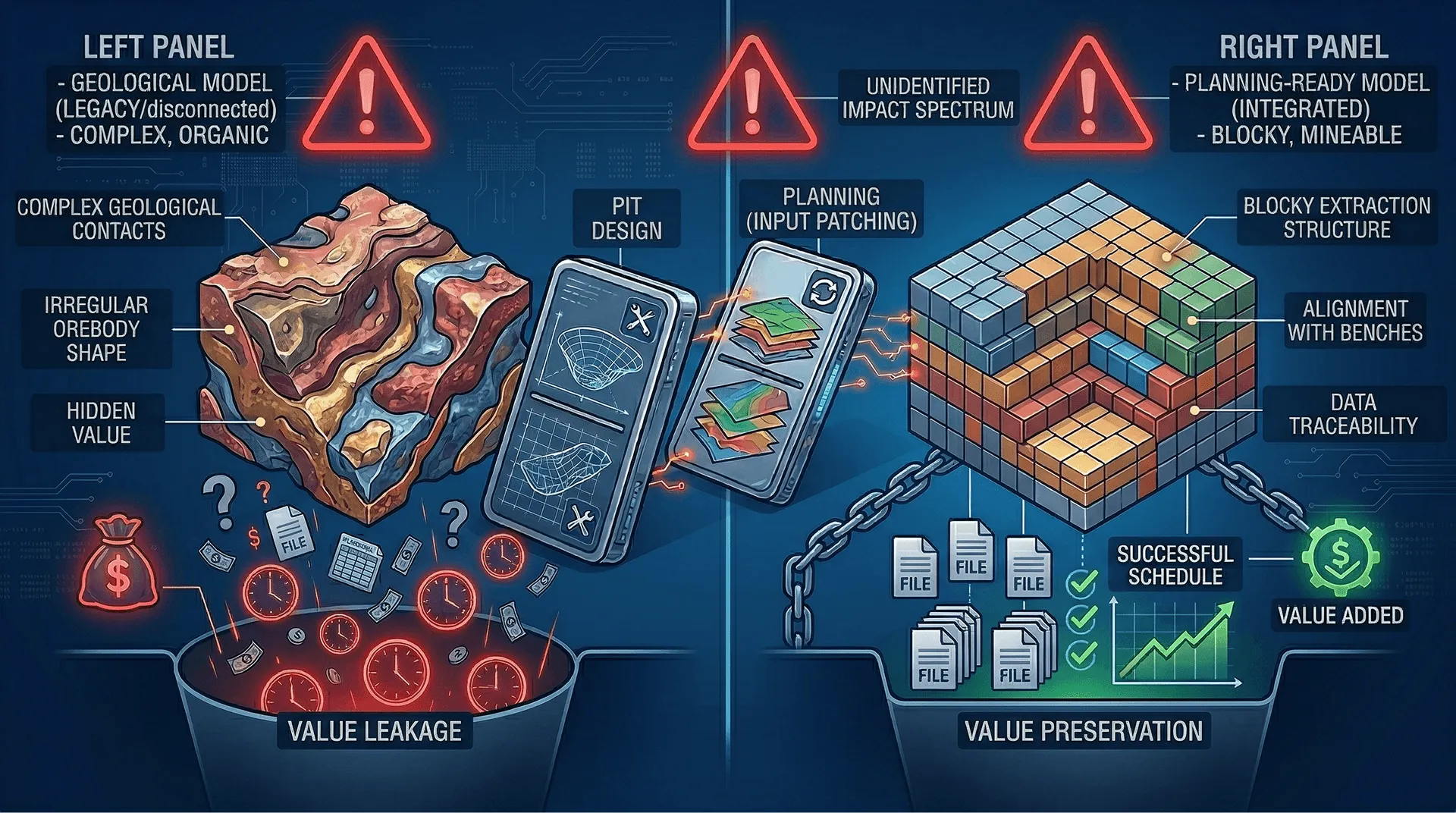
The first hidden cost is rework. Not the obvious kind, where a design is thrown out completely, but the constant low-level rework that becomes normal in fragmented environments. A geological update arrives, so solids need to be checked again. A topographic surface changes, so access geometry needs revision. A phase boundary moves, so mining units need to be reflagged. A scheduling assumption changes, so the sequence must be rebuilt in a slightly different way.
None of this sounds catastrophic in isolation. But across a study or operating mine, it adds up into a serious drag on engineering productivity. Instead of moving the plan forward, teams spend their time repairing the path between disciplines.
The second cost is slower iteration - and this is even more important. In mining, value is often found through comparison, not through the first answer. Teams need to test alternative cut-off strategies, production rates, phase orders, pushback options, destination rules, equipment assumptions, or development priorities. But when the workflow is disconnected, each new scenario becomes expensive. It is not just a new run. It becomes a new round of exports, conversions, checks, and local fixes.
That slows decision-making at exactly the point where the project should be learning.
The third cost is loss of traceability. Once a project starts moving through multiple disconnected files, intermediate exports, spreadsheets, and local assumptions, it becomes harder to answer a very basic management question: what changed? Not just whether the schedule changed, but why it changed, which upstream assumption caused it, and whether the result is genuinely better or simply different.
That lack of traceability makes internal review slower and often more political. Engineers spend time defending versions instead of improving them. Managers lose confidence because two technically competent people can produce two different outputs from what was supposed to be the same planning basis.
This is where disconnected workflows start hurting business performance, not just technical cleanliness. If a planning chain is slow and opaque, the organization becomes more conservative. Teams test fewer cases. They avoid updates unless absolutely necessary. They freeze assumptions earlier than they should. They carry known issues forward because reopening the workflow is too painful.
In other words, the project starts optimizing for internal convenience rather than for technical quality or economic value. That is a bad trade, and it happens more often than many teams like to admit.
There is also the confidence problem. A schedule may look polished in presentation form, but if the path from model to design to sequence is fragmented, the technical team often knows how fragile that result really is. They know where assumptions were patched manually. They know which data transfer was awkward. They know which part of the sequence took too much hand correction.
That matters because confidence in a plan is not only about whether it runs mathematically. It is also about whether the team trusts its lineage. If a schedule is difficult to update, difficult to explain, and difficult to reconcile with upstream data, then it is not a strong planning product - even if the charts look beautiful.
So the hidden cost is bigger than wasted hours. It is lost agility. It is weaker learning. It is lower trust in outputs. It is fewer scenarios tested, slower adaptation to new information, and more planning energy spent on managing internal friction.
That is why disconnected workflows are not just an IT nuisance or a software preference issue. They are a structural drag on technical and economic performance.
Practical Situations Where Value Leakage Becomes Visible
The easiest way to understand workflow value leakage is to look at the moments when it stops being theoretical and starts hurting a real project. In most mines and studies, the problem does not appear as a dramatic system failure. It shows up when a perfectly reasonable update in one part of the workflow triggers a completely disproportionate amount of downstream effort.
That is the signature of a disconnected planning chain: small changes upstream create heavy manual consequences downstream.
One very common example is a geological model update that arrives late in a study or during active mine planning. New drilling tightens domain boundaries, grade continuity changes, or density relationships are revised. None of that is unusual. In fact, it is normal. The trouble begins when that update cannot move cleanly into design and schedule. Pushbacks need to be adjusted, mining areas need to be reflagged, timing of ore exposure changes, and the scheduling team ends up rebuilding logic around shapes that are no longer quite the same.
Another classic situation is topography correction. Survey improves the surface model, or new LiDAR data refines terrain and access geometry. On paper, that sounds like a straightforward technical update. In reality, even a modest terrain correction can affect collar positions, haul access, ramp feasibility, bench geometries, local strip ratio, and timing of ore release.
If geology, design, and scheduling are loosely linked, this type of update tends to cause an ugly chain reaction: redesign of local areas, revised mining units, new reserve checks, and schedule adjustments that consume far more effort than the underlying change should have required.
A third case appears when planning teams need to test alternatives quickly, but the workflow is too fragmented to support fast iteration. Management wants to compare two production profiles, test a different cut-off strategy, or see whether a sequencing change improves early cash flow without destroying plant feed stability. In a connected workflow, that should be demanding but manageable. In a disconnected one, every scenario becomes its own little engineering campaign. Data gets exported again. Shapes are adjusted again. Mining units are rebuilt again. The schedule is effectively reconstructed rather than updated.
There is also a very practical consultant-to-owner handoff problem that many teams know too well. A consultant delivers geology and perhaps reserve-related outputs in one structure and format, while the owner’s internal planning team works in another software environment or under different operational logic. Technically, the information exists. But in practice, the owner’s team still has to reinterpret, remodel, or restructure key elements before they can use them for detailed planning or operational scheduling.
That kind of time lost in translation is rarely shown in project economics, but it is real. It delays follow-on work, weakens continuity between study phases, and often creates subtle differences between the original intent of the model and the version that finally gets used for planning.
Open-pit mines offer another visible example through mining-width and equipment-access constraints. A phase layout can look reasonable in geometric terms, yet become awkward once the scheduling team tries to turn it into a workable extraction sequence with enough operating room for fleet movement and acceptable production stability.
Short-term planning introduces a similar problem from the operational side. Once a mine has to coordinate equipment movement, active faces, material routing, and production targets over short horizons, disconnected upstream logic becomes painfully obvious. If the planning workflow is already fragmented at long- and medium-term levels, short-term planning ends up carrying even more reconciliation burden.
And then there is the operating-mine version of the same story. A mine is already running, so the assumption might be that the workflow must be working well enough. Not necessarily. Many operations survive with planning systems that are technically functional but operationally heavy. They can still produce schedules, but only through repeated manual alignment between departments.
The pattern across all these situations is the same. The project does not lose value because updates happen. Updates are normal. It loses value because the workflow cannot absorb them without excessive manual effort, local reinterpretation, and loss of traceability.
That is the real issue. A dynamic mine needs a planning chain that can behave dynamically too.
What a Better, Connected Geology-to-Schedule Workflow Looks Like
A better workflow is not just one with fewer files or cleaner dashboards. In mining, a genuinely connected workflow is one where geological updates, design logic, and scheduling decisions move through the planning chain with minimal manual reconstruction.
That does not mean every discipline becomes the same job, and it definitely does not mean geology, engineering, and operations stop challenging each other. It means the handoffs become cleaner, assumptions become more transparent, and the project can absorb change without turning every update into a separate engineering exercise.
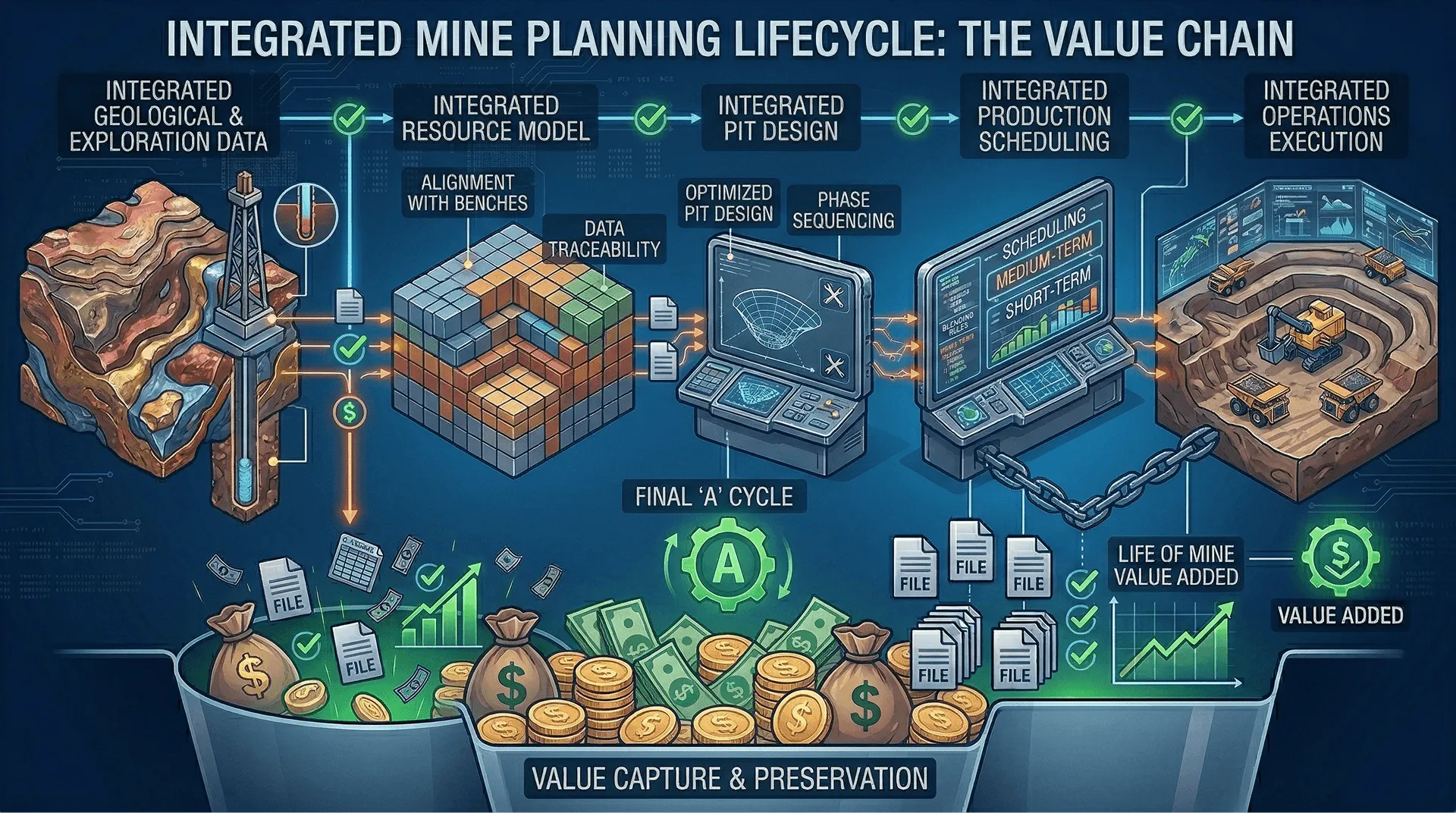
At a practical level, a connected geology-to-schedule workflow has several clear characteristics. First, the geological model is structured not only for estimation and reporting, but also for downstream engineering use. That means planning-relevant attributes, consistent coding, clean surfaces and solids, and data that can travel into design and scheduling without being rebuilt manually.
Second, design outputs are created with schedule behavior in mind. Pushbacks, phases, stopes, access logic, and mining areas are not treated as static geometry that gets handed off downstream and adjusted later in isolation.
Third, scheduling is not treated as the final export step, but as an active test of whether the upstream workflow is coherent enough to support real production logic.
When that connection is in place, updates become far less painful. A revised domain, an updated terrain model, or a changed mining assumption still matters, of course. But the response is faster and more traceable. The team is no longer asking, “Which spreadsheet did we use last time?” It is asking, “What changed in the model, what does it do to the design, and what does it do to the schedule?”
That difference may sound small, but in real project terms it is huge. It changes the workflow from a sequence of isolated technical steps into a connected planning system.
Another important feature of a better workflow is reduced redesign effort. If a project needs to revise phase geometry, update mine layouts, or re-test alternatives after new information arrives, the team should not have to rebuild large parts of the work from scratch. A stronger planning environment makes it easier to update design parameters, preserve previous engineering logic where appropriate, and compare revised alternatives more quickly.
That matters especially in study work and active operations, where assumptions rarely stay frozen for long.
A connected workflow also improves traceability - and that is a bigger advantage than many teams realize. In fragmented planning chains, version confusion is almost guaranteed sooner or later. One team updates the block model. Another adjusts the design locally. A scheduler modifies assumptions to make the sequence workable. Management eventually receives a result that may be technically defensible but difficult to audit.
Better-connected workflows make those relationships easier to see. They do not eliminate engineering judgment, but they make the lineage of the plan more transparent. That transparency matters when projects are reviewed internally, defended in studies, or updated under time pressure.
The deeper point is that a connected workflow does not simply save engineering hours, though it does that too. It changes how a project learns. Teams can test more scenarios, respond faster to new geological information, and compare alternatives with less manual overhead. That makes the whole planning system more adaptive and, usually, more honest.
Weak workflows tend to push organizations toward early assumption freeze, fewer scenario tests, and a quiet reluctance to reopen the model. Stronger workflows do the opposite. They make updates manageable.
So when people talk about integration in mining software, the useful question is not whether everything sits under one logo or in one folder. The useful question is whether the workflow helps the team move from geological understanding to design decisions to schedule logic with less friction, better traceability, and faster iteration.
If the answer is yes, the mine gains a planning advantage. If the answer is no, then even technically strong teams will keep losing time in the gaps.
Why Faster Iteration Is Becoming a Real Competitive Advantage
For a long time, mine planning was judged mainly by whether a team could produce a technically defensible answer. That is still essential, obviously. But it is no longer enough.
In today’s environment, the stronger competitive advantage often comes from how quickly a team can move from new information to a revised decision. That shift matters because mining projects now operate under more volatile inputs, tighter capital discipline, and higher expectations around operational responsiveness.
That changes the standard for planning. The old model was built around periodic technical outputs: update the model, revise the design, rebuild the schedule, publish the result. The newer reality is much less patient. Teams need to respond to geological updates, changing cost assumptions, revised production priorities, equipment constraints, and operational feedback without turning every revision into a six-week internal campaign.
In that environment, speed of iteration is not just an efficiency metric. It directly affects project quality, decision quality, and sometimes even economics.
This matters at both study and operating-mine level. In a study, faster iteration means more scenarios can be tested before major decisions are locked in. That can improve phase strategy, production targets, cut-off logic, destination policies, and risk framing. In an operating mine, faster iteration means the planning system can absorb reality without constantly breaking.
A changed topographic surface, a revised domain interpretation, a geotechnical update, or a shift in plant constraints should not force the organization into planning paralysis. If each change requires too much manual rebuilding, the mine becomes slower not because the orebody is difficult, but because its planning workflow is too rigid.
The strategic implication is blunt. Two mining teams may both be technically capable. Both may have good geologists, good engineers, and decent software. But if one team can test alternatives and absorb updates with much less friction, that team will usually make better decisions over time. It will compare more options, react faster to surprises, and spend less energy defending old versions.
In a business where uncertainty never fully disappears, that agility compounds. It improves not just planning speed, but planning quality.
This is also where a lot of AI talk in mining either becomes real or turns into nonsense. AI-enabled operations are only useful if the underlying workflow is connected enough to feed reliable information into the decision chain. If geology, design, scheduling, and execution are fragmented, then adding smarter analytics on top does not solve the core problem. It just makes the mess more sophisticated.
But when the planning chain is well connected, advanced analytics can actually help teams test options faster, detect issues earlier, and reduce routine manual work.
So faster iteration is not a nice extra anymore. It is becoming one of the clearest differentiators between planning systems that simply produce outputs and planning systems that create operational advantage.
Mines do not win by freezing assumptions and hoping reality cooperates. They win by learning faster than the workflow breaks.
Conclusion
Most mining projects do not lose time and value because one discipline fails in isolation. They lose it in the handoffs. The geological model may be technically strong, the design may be well engineered, and the schedule may look polished - but if the workflow between those steps is fragmented, the project pays for it through rework, slower iteration, lower traceability, and weaker confidence in results.
That is why the path from geological model to mine schedule deserves more attention than it usually gets. It is not just a technical sequence. It is the backbone of planning quality. When that backbone is weak, every update becomes expensive. When it is strong, teams can move from new geological understanding to revised engineering decisions with less friction and more confidence.
For mining companies, the practical takeaway is simple. The goal is not just to produce a model, then a design, then a schedule. The goal is to build a planning chain that can survive change. In a sector where geology evolves, constraints shift, and operational reality keeps pushing back, that ability is no longer optional. It is one of the clearest ways to protect time, protect value, and make better decisions across the life of mine.