When Outsourcing Works
In a capital-intensive and skills-constrained industry like mining, outsourcing is often the only viable path to operational efficiency. Used strategically, it allows companies to reduce fixed overhead, access world-class expertise, and accelerate project execution. When applied to the right areas, outsourcing doesn’t just cut costs—it increases returns.
Technical and scientific services are classic examples. Outsourcing laboratory analysis—whether for geochemistry, metallurgical testing, or mineralogy—is now standard practice. According to S&P Global data, over 80% of junior exploration companies outsource core sample analysis due to the prohibitive cost of maintaining accredited labs. ALS, SGS, and Bureau Veritas process millions of samples per year globally, delivering results faster and with higher QA/QC standards than most internal labs can manage. For an average exploration project, outsourcing lab services can reduce analytical costs by 30–50% compared to building an in-house facility.
Digital transformation projects are another area where outsourcing yields strong ROI. A 2022 McKinsey report found that mining companies which outsourced IT integration for digital mine planning systems achieved deployment 2.5x faster on average than those that tried to build internal teams. One mid-tier gold producer in West Africa outsourced the full implementation of its mine scheduling and dispatch systems to a South African consultancy. The result: a 17% improvement in fleet utilization and a $3.2M annual reduction in fuel and maintenance costs within 12 months.
Engineering and infrastructure construction are also frequently outsourced, especially in jurisdictions with complex permitting or terrain. In Chile’s Atacama region, Lundin Mining outsourced the full EPCM package for its Candelaria expansion to Fluor Corporation. The move allowed the company to complete the project 4 months ahead of schedule and saved an estimated $46M compared to internal execution forecasts. In remote areas of Africa and Central Asia, companies often rely on regional contractors who already have logistical and political relationships in place—cutting through red tape and reducing mobilization costs.
When preparing for financing or sale, mining companies often engage independent consultants to prepare technical documentation, resource/reserve statements, and environmental reports. This isn’t just efficient—it’s a requirement. Investors and lenders typically demand third-party validation of key data. For example, during the $1.1B acquisition of Yamana Gold’s Canadian assets in 2023, the buyer mandated full re-validation of resource models and life-of-mine plans by independent QPs. The cost of the outsourced audit was under 0.3% of the transaction value, yet it played a critical role in de-risking the deal.
In all of these examples, success comes from using outsourcing as a precision tool—applied to tasks that are specialized, short-term, or outside the company’s strategic focus. It reduces capital exposure, speeds up execution, and often delivers higher-quality outcomes. But to extract these benefits, companies must retain internal ownership over strategy and decision-making. Outsourcing execution is effective. Outsourcing thinking is dangerous.
When Outsourcing Fails
While outsourcing can unlock speed and flexibility, it also carries significant risk when misapplied. The mining industry has seen repeated cases where over-reliance on external providers, unclear scopes of work, or poor integration with internal teams have led to delays, cost overruns, regulatory failures, and even complete project collapse. The consequences are often not only financial, but strategic—eroding trust with investors, disrupting operations, and triggering litigation.
A common pitfall is outsourcing core operational functions, especially those that require constant feedback loops, safety oversight, or strategic judgment. Drilling and blasting is a case in point. While it might seem cost-effective to outsource entire drill-and-blast operations, doing so without strict control frameworks often results in poor fragmentation, suboptimal timing, and higher downstream costs. A mid-sized copper mine in Zambia reported a 12% increase in processing costs after outsourcing blasting to a regional contractor. Poor fragmentation led to excessive fines and throughput loss in the mill, wiping out the perceived savings on drill-and-blast labor.
Mine planning is another area where over-outsourcing can backfire. Planning requires constant adjustment to real-world conditions—weather delays, equipment availability, geotechnical events. In 2021, a Mongolian coal operation outsourced its weekly and monthly planning to an overseas firm. Time zone misalignment and lack of on-site feedback created a 10–15 day lag between events and response. The result was chronic equipment underutilization and several missed production targets, costing the company over $8M in lost revenue across one year.
Another critical risk is loss of control over data and intellectual capital. In several high-profile disputes, mining companies have found themselves locked out of their own digital models or geological databases due to poorly defined ownership clauses in service contracts. One junior exploration company in Canada lost access to its entire 3D block model and geostatistical dataset after a disagreement with the outsourced modeling firm. The cost of rebuilding the model from raw logs was over $250,000 and delayed the feasibility study by six months—ultimately causing the loss of a financing opportunity.
Regulatory compliance is also at risk when outsourcing is poorly managed. A South American polymetallic operation faced sanctions and a partial shutdown after an external environmental consulting firm failed to properly submit updated impact assessment reports during a permit renewal cycle. Although the operator had delegated the task, regulators held the company accountable. The financial impact included not only fines, but also reputational damage that affected local stakeholder relations and future permitting efforts.
What links these failures is usually not the idea of outsourcing itself, but the lack of clear contracts, internal oversight, and long-term strategy. Mining projects are high-risk, multi-variable systems. Outsourcing can handle components—but when companies start treating outsourced providers as end-to-end substitutes for internal capability, they lose situational awareness. That’s when critical errors slip through.
The failures often emerge when:
- There’s no internal “owner” of the outsourced work.
- KPIs and deliverables are not well-defined in contracts.
- Communication between the contractor and operational teams is broken or delayed.
- Strategic or compliance-sensitive tasks are handed off without validation mechanisms.
In the worst cases, companies even outsource the interpretation of their own geological models or mine plans—effectively removing themselves from decision-making. This creates not only technical risk, but fiduciary risk. Investors are increasingly scrutinizing whether operators have internal control over technical decisions. A company that cannot explain its own model assumptions or schedule rationale is unlikely to raise serious capital.
Outsourcing is a tool. Used carelessly, it can cause deep structural damage. But when companies maintain strategic control, assign internal accountability, and treat contractors as partners—not replacements—it remains a powerful lever for growth and efficiency.
How to Do It Right
Outsourcing in mining is not a one-size-fits-all solution. To create value, it must be managed with the same level of attention and discipline as core operations. The companies that succeed with outsourcing are not those that push work out the door—they are those that build internal systems to absorb, control, and extract value from external workstreams. In high-stakes environments like mining, where decisions affect not just margins but safety, license to operate, and long-term asset value, the governance of outsourcing becomes a core competency in itself.
The first step is structural: a clear distinction between core and peripheral functions. Core functions—those tied directly to strategic outcomes—should always remain under internal ownership. This includes geological modeling, mine planning, production scheduling, safety oversight, and regulatory compliance. Even if some technical tasks within these domains are executed externally, responsibility and interpretation must stay in-house. A mining company that outsources its production schedule to a third party but cannot explain its assumptions to a board or investor is not managing risk—it’s creating it.
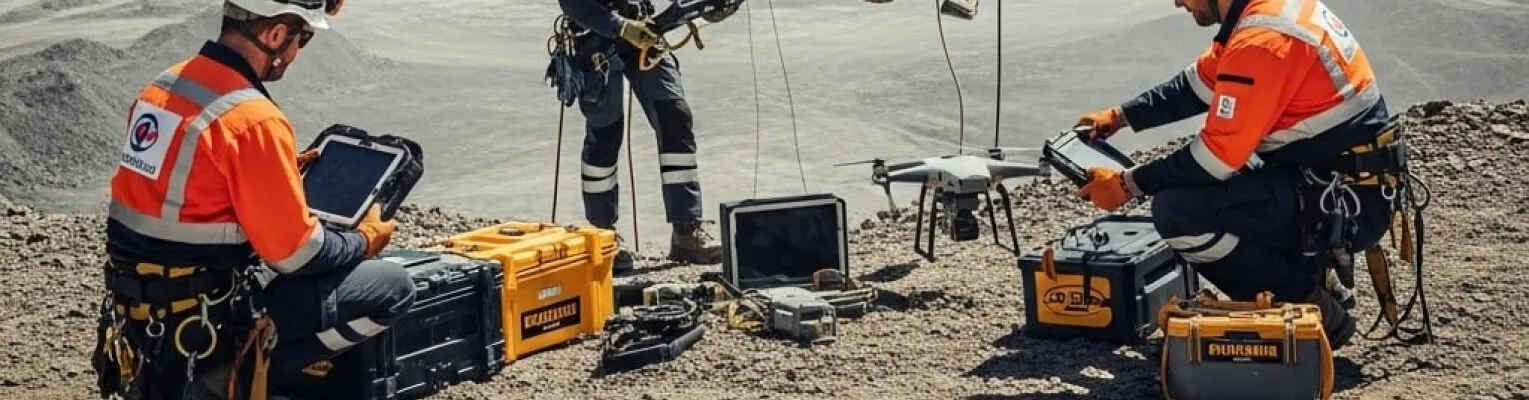
On the other hand, peripheral or episodic functions are ideal candidates for outsourcing. These include drone-based surveys, laboratory testing, road construction, pit dewatering, and the setup of digital infrastructure. These activities are either infrequent, highly standardized, or require equipment and knowledge that would be inefficient to maintain internally. For instance, a uranium developer in Namibia outsourced all topographic work to a drone services provider with RTK technology. This saved over $400,000 in survey equipment and training, while cutting terrain model delivery time from three weeks to five days—without losing internal control, as the company retained data validation in-house.
Once the strategic boundary is set, the next requirement is internal ownership of outsourced outcomes. This means every outsourced task or process must have a designated internal lead. This person is accountable for coordinating inputs, verifying deliverables, and maintaining communication between the external provider and internal teams. In practice, this transforms outsourcing from a black-box process into a transparent, trackable component of operations.
For example, during the development of a polymetallic mine in Central Asia, the operator outsourced environmental baseline studies to a European consultancy. However, the internal environmental officer remained responsible for validating every report before submission to regulators. This hybrid model ensured that local realities were reflected in the analysis, and that final accountability stayed with the operator. When permitting was challenged later by NGOs, the company could stand behind its data because it had controlled the process—not just the paper trail.
The third pillar of successful outsourcing is contractual structure. Service Level Agreements (SLAs), Key Performance Indicators (KPIs), and performance-linked incentives must be embedded into every contract. Too often, mining companies operate on vague scopes of work that specify deliverables without defining standards or consequences. This leads to rework, delays, and scope creep.
One best-in-class example comes from an iron ore producer in Brazil. The company outsourced blasting operations to a regional contractor but linked payment milestones to downstream mill throughput, measured daily. If fragmentation quality declined, contractor fees were reduced in the same month. This contract structure incentivized both parties to focus on operational results—not just task completion.
Over 18 months, mill throughput improved by 11%, and specific energy consumption dropped by 6%, translating to savings of over $5.5M.
Another contractual risk is data ownership. Every mining company should assert in its contracts full, irrevocable rights over all datasets, models, and digital files produced by contractors. This includes source files, audit trails, software outputs, and intermediate calculations. Failure to do this can paralyze a project. In one real case, a lithium developer in Argentina lost access to its hydrological model after terminating a contract with an external consultant. The consultant refused to hand over the raw simulation files, and the company was forced to re-run the entire model through a different firm—delaying the project by six months and causing a 9% share price drop following missed milestone disclosures.
Retaining control over digital architecture and raw data is especially critical in an era of cloud-based mining software and remote technical teams. Companies should ensure that all externally developed files are stored in internally administered repositories, with proper version control and metadata. Regular audits should verify that all outputs are backed up and accessible to internal teams regardless of contractor availability.
Finally, the most resilient outsourcing models in mining are hybrid systems. These combine permanent internal teams for strategic functions with external partners for execution and scale. For example, a copper miner in Kazakhstan maintains an internal mine planning team responsible for quarterly scheduling and life-of-mine strategy, but outsources daily short-term scheduling and dispatch optimization to a local firm with specialized expertise in open-pit operations. The result: consistent strategic alignment with dynamic tactical adaptability.
In such hybrid models, the internal team acts as an integrator—not a bottleneck. They ensure consistency across software, assumptions, geodata formats, and production priorities. At the same time, they allow operational flexibility and cost control by delegating high-frequency execution tasks to the market.
The reality is that mining companies today are being evaluated not only by their ore grades or NPV, but by their organizational maturity—their ability to operate reliably, transparently, and efficiently in complex environments. Outsourcing, when done well, becomes a competitive asset. It extends reach, fills skill gaps, and accelerates timelines. But it only works when the mine owner stays in the driver’s seat.