











 Back
Back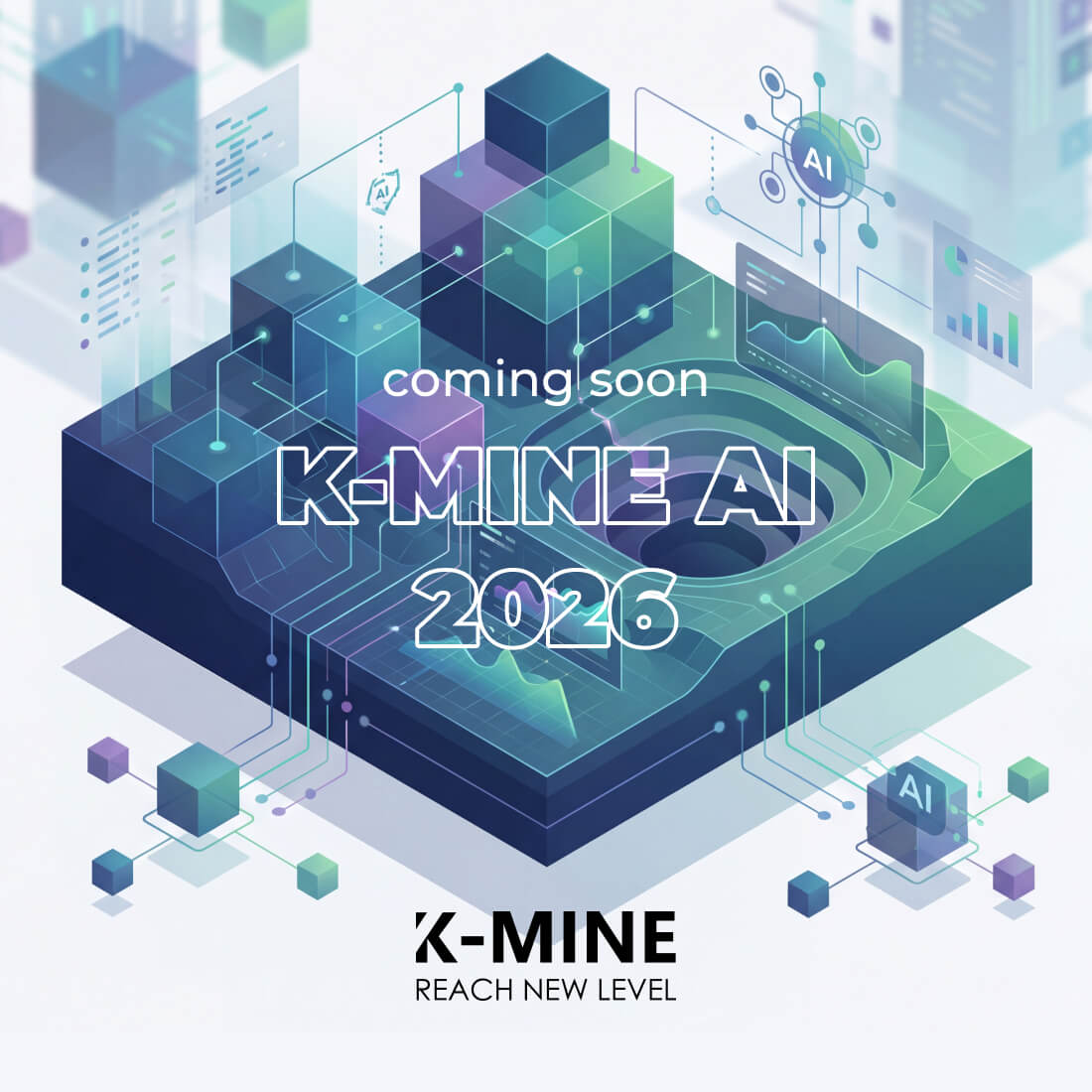 The mining software industry has seen plenty of AI announcements over the past two years. Most focus on vague promises about “machine learning integration” without addressing specific technical problems. We’re taking a different approach – solving concrete challenges that resource geologists and mine planners deal with every day. This article covers our AI development focus for 2026, with automated block modeling coming to beta in May.
The Problem We’re Solving First
Constructing a defensible block model requires iterative workflows: compositing, exploratory data analysis, variogram modeling, search neighborhood optimization, interpolation, cross-validation, parameter adjustment. A competent resource geologist spends days or weeks on this cycle.
The bottleneck isn’t computation. It’s the expert time required to make hundreds of small decisions. What lag distance captures the true spatial structure? Is that nugget effect real or sampling noise? Where exactly should domain boundaries fall? These decisions compound – a questionable variogram propagates through search ellipsoid definition into final estimates.
Traditional methods have known limitations. Kriging assumes local stationarity within domains – an assumption that rarely holds perfectly. The method struggles with sparse data and can produce over-smoothed estimates. Inverse distance ignores spatial correlation entirely. Both require extensive manual parameterization.
Our Approach: Multi-Model Ensemble Estimation
Rather than relying on a single neural network alone, we developed a system that combines multiple estimation methods and synthesizes results.
Automated domain identification. Clustering algorithms analyze spatial grade distribution and identify statistically distinct populations. This addresses one of the most time-consuming aspects of resource estimation – defining domains that honor both spatial continuity and grade characteristics. Automated clustering provides a defensible starting point that geologists can refine rather than build from scratch.
Parallel model training. For each domain, we train multiple model types simultaneously: tree-based ensemble methods for non-linear grade relationships; gradient boosting algorithms for regression accuracy; generative networks that learn underlying grade distributions; sequence-aware architectures that capture directional geological trends.
Each model type brings different mathematical assumptions. Tree-based methods handle sharp grade boundaries well. Gradient boosting captures complex feature interactions. Neural architectures identify patterns that traditional methods miss.
Meta-model synthesis. Predictions from individual models are combined using ensemble learning with spatial smoothing. The system weights each model’s contribution based on cross-validation performance. Final estimates represent a weighted consensus that minimizes prediction variance while maintaining geological plausibility.
Why Ensemble Beats Single-Algorithm Approaches
Single algorithms have documented failure modes. Neural networks can overfit training data, producing impressive statistics but geologically implausible results in prediction zones. They may learn spurious correlations between coordinates and grades rather than genuine geological relationships.
Traditional kriging requires careful variogram modeling – and variograms are sensitive to outliers, data clustering, and analyst choices. Two competent geostatisticians working the same dataset may produce meaningfully different resource estimates.
An ensemble approach mitigates these risks through model diversity. When one method produces anomalous predictions, others provide correction. The system also generates uncertainty metrics based on agreement between models – where they converge, confidence is high; where they diverge, the system flags areas requiring geological review.
Workflow Integration
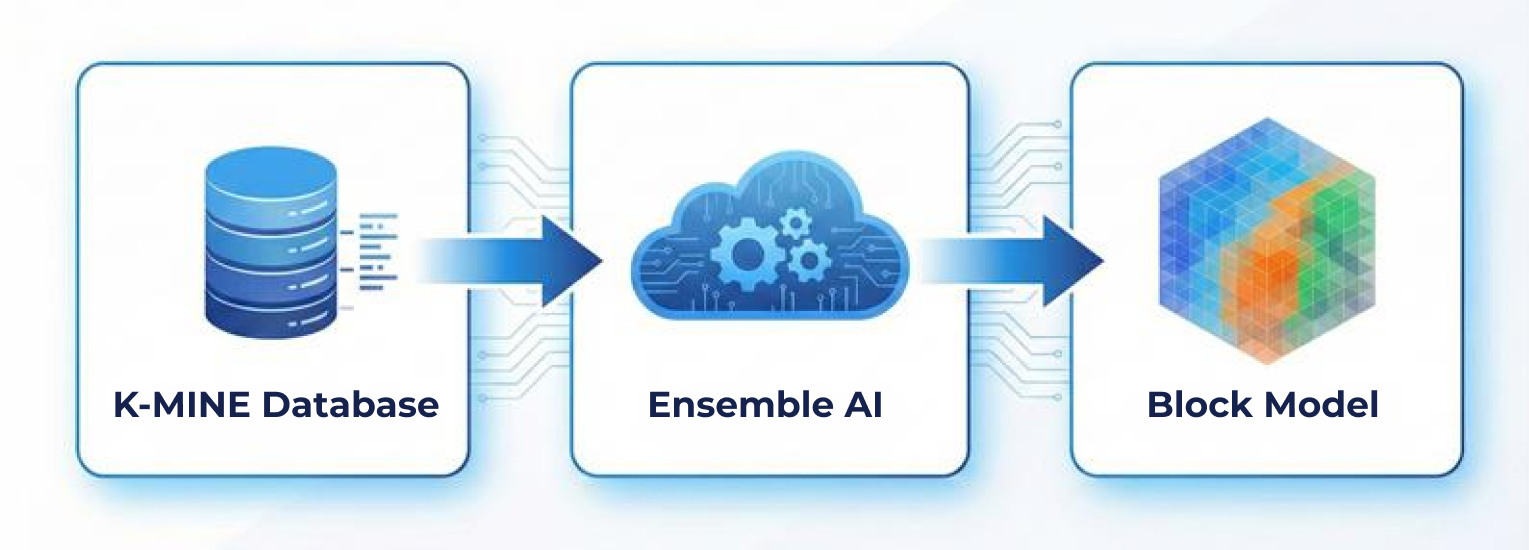
Input: composite data from K-MINE geology database. Users select target elements, optionally define constraining wireframes, and the system generates a block model. Processing runs on cloud infrastructure, returning results to the K-MINE desktop environment. No separate software, no manual file transfers.
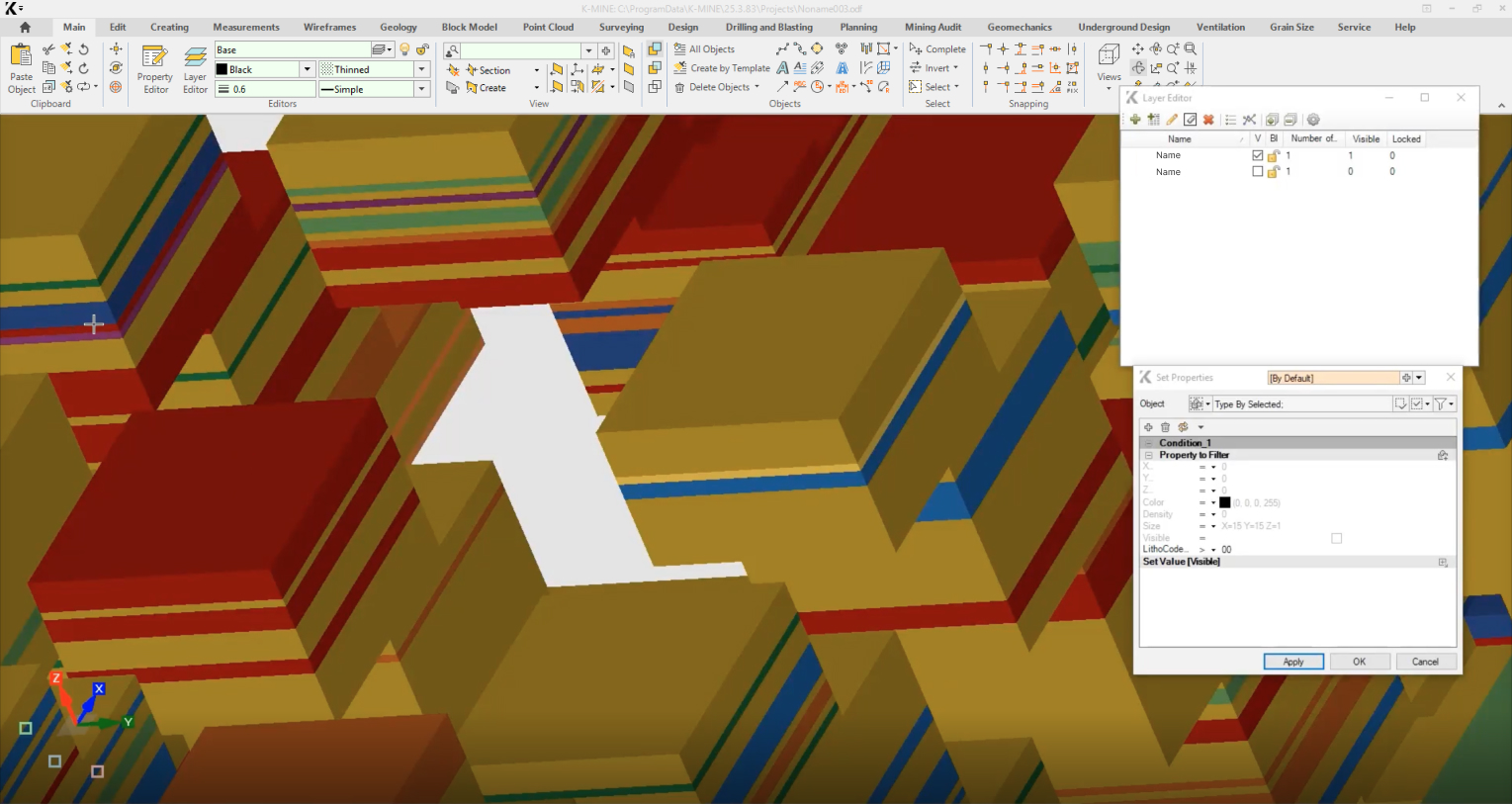
Output: complete block model with per-element estimates and confidence metrics, ready for visualization, resource classification, and downstream workflows.
What’s Next: Mine Planning
Parallel to grade modeling, we’re developing AI-assisted tools for open pit planning – specifically targeting problems that current software handles poorly: automated volume selection under multiple constraints (tonnage, grade, strip ratio, rock type limits), transport network optimization for ramp placement, and conversion of block-based results to design-ready geometry. These tools are in active development with initial releases planned for second half of 2026.
Sign up for AI Block Modeling Beta
Beta launch: May 2026. Leave your details and we’ll reach out when the program starts.
 Subscribe to newsletter
  Follow K-MINE on LinkedIn